




Six Sigma is a powerful methodology that has transformed countless businesses across the globe, and at the heart of this transformation are the Master Black Belts. These professionals are not just experts in Six Sigma principles; they wield advanced tools and statistical techniques that enable organizations to enhance quality, reduce waste, and improve overall performance. In this blog, we will delve into the advanced tools and statistical techniques utilized by Master Black Belts, focusing on how these contributions drive excellence in organizations, especially in the Indian context.
Understanding the Role of a Master Black Belt in Six Sigma
Before we explore the advanced tools and techniques, it's essential to understand the role of a Master Black Belt in the Six Sigma framework. A Master Black Belt serves as a mentor, trainer, and leader in Six Sigma initiatives. They possess a deep understanding of the methodology and its application, guiding teams in the successful implementation of projects. Their expertise is vital in identifying areas for improvement and utilizing data-driven decisions to achieve strategic goals.
Advanced Six Sigma Tools Used by Master Black Belts
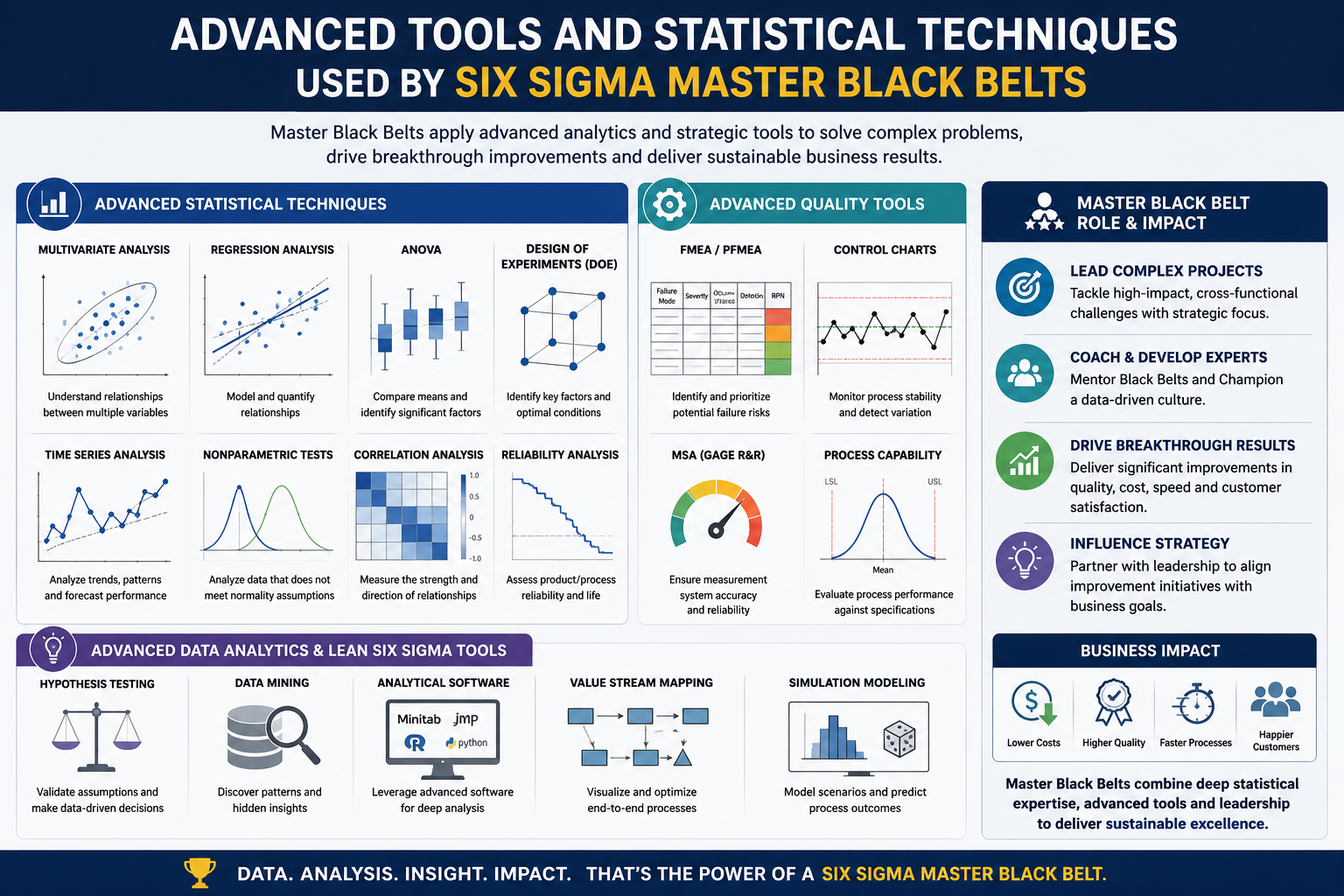
Master Black Belts employ a variety of advanced Six Sigma tools to facilitate process improvement. Here are some of the most crucial tools:
1. Statistical Process Control (SPC)
Statistical Process Control is an essential tool for Master Black Belts. It involves using statistical methods to monitor and control a process. By analyzing data collected over time, Master Black Belts can identify trends, variations, and potential issues before they escalate. This proactive approach allows organizations to maintain quality and efficiency in their processes.
2. Design of Experiments (DOE)
Design of Experiments is a sophisticated technique that enables Master Black Belts to systematically test multiple variables simultaneously. This tool helps in identifying the factors that significantly impact process outcomes. By optimizing these variables, organizations can achieve better quality and performance with minimal resources.
3. Failure Mode and Effects Analysis (FMEA)
FMEA is a risk assessment tool that Master Black Belts use to identify potential failures in a process or product and assess their impact. By prioritizing these risks, organizations can implement corrective actions to mitigate them, ultimately enhancing quality and customer satisfaction.
4. Lean Tools
Master Black Belts often integrate Lean methodologies with Six Sigma principles. Tools such as Value Stream Mapping, 5S, and Kaizen are employed to eliminate waste and streamline processes. These Lean tools complement Six Sigma's focus on quality, creating a comprehensive approach to process improvement.
5. Root Cause Analysis (RCA)
Root Cause Analysis is a critical tool for identifying the underlying causes of problems. Master Black Belts utilize various techniques, such as the 5 Whys and Fishbone Diagram, to dissect issues and implement effective solutions. This ensures that organizations address not just the symptoms but the root causes of quality problems.
Statistical Techniques for Master Black Belts
Alongside advanced tools, Master Black Belts leverage various statistical techniques to analyze data and drive decision-making. Here are some key statistical techniques:
1. Hypothesis Testing
Hypothesis testing is a crucial statistical technique that Master Black Belts use to validate assumptions about a population based on sample data. By determining whether the observed effects are statistically significant, organizations can make informed decisions regarding process improvements.
2. Regression Analysis
Regression analysis helps Master Black Belts understand relationships between variables. By identifying correlations, they can predict outcomes and determine which factors influence performance. This technique is invaluable in forecasting and improving processes.
3. Control Charts
Control charts are graphical tools that Master Black Belts use to track process behavior over time. By plotting data points on a control chart, they can quickly identify trends, shifts, and variations, allowing for timely interventions to maintain quality.
4. Capability Analysis
Capability analysis evaluates how well a process meets specified requirements. Master Black Belts use this technique to assess process capability indices (Cp, Cpk) and determine if processes are capable of producing products within specification limits. This insight is critical for continuous improvement.
Master Black Belt Methodology
The Master Black Belt methodology encompasses a structured approach to problem-solving and process improvement. It typically involves the following phases:
1. Define
In the Define phase, Master Black Belts identify the problem and establish project goals. They engage stakeholders to ensure alignment and gather initial data to understand the scope of the issue.
2. Measure
The Measure phase involves collecting data to quantify the problem. Master Black Belts employ various measurement tools and techniques to gather relevant information, enabling them to analyze the current process state.
3. Analyze
During the Analyze phase, Master Black Belts use statistical techniques to identify root causes and patterns in the data. This phase is critical for understanding the underlying factors contributing to the problem.
4. Improve
In the Improve phase, Master Black Belts develop and implement solutions based on their analysis. They often utilize tools like Design of Experiments to test and validate improvements before full-scale implementation.
5. Control
The Control phase ensures that improvements are sustained over time. Master Black Belts establish monitoring systems and control plans to maintain process performance and prevent regression.
FAQs
1. What is the role of a Master Black Belt in Six Sigma?
A Master Black Belt is responsible for mentoring and training Six Sigma practitioners, leading projects, and ensuring the successful implementation of Six Sigma initiatives within an organization.
2. What are the key tools used by Master Black Belts?
Some of the key tools include Statistical Process Control (SPC), Design of Experiments (DOE), Failure Mode and Effects Analysis (FMEA), Lean tools, and Root Cause Analysis (RCA).
3. How do statistical techniques enhance Six Sigma projects?
Statistical techniques provide data-driven insights that help Master Black Belts identify patterns, validate hypotheses, and make informed decisions to improve processes and quality.
Conclusion
Master Black Belts are integral to the success of Six Sigma initiatives, armed with advanced tools and statistical techniques that drive continuous improvement. As businesses in India strive for excellence, understanding and leveraging these methodologies becomes essential. By investing in Master Black Belt training and embracing the tools and techniques discussed, organizations can achieve remarkable outcomes in quality and efficiency.
Call to Action
Are you ready to elevate your organization's performance with Six Sigma? Invest in Master Black Belt training today and equip your team with the advanced tools and statistical techniques needed to drive success. Contact us now to learn more about our training programs!