

Six Sigma Training is a structured process improvement methodology that helps individuals and organizations reduce errors, improve quality, optimize operations, and achieve business efficiency. It includes different certification levels such as White Belt, Yellow Belt, Green Belt, Black Belt, and Master Black Belt, enabling professionals to build expertise in quality management and operational excellence.
What is Six Sigma Training? Complete Beginner’s Guide to Certification, Levels & Career Benefits
Introduction
Businesses today operate in highly competitive environments where quality, efficiency, customer satisfaction, and cost optimization directly influence growth. Organizations are constantly looking for ways to eliminate waste, improve processes, and enhance productivity. This is where Six Sigma Training plays an important role.
Originally developed by Motorola in the 1980s and later adopted globally by companies such as General Electric, Amazon, Ford, and healthcare institutions, Six Sigma has evolved into one of the most recognized methodologies for process improvement and quality management.
Whether you are a student exploring career options, a working professional aiming for growth, an HR leader building workforce capability, or a business owner seeking operational excellence, understanding Six Sigma can create long-term value.
This beginner’s guide explains Six Sigma Certification, levels, methodologies, career opportunities, and practical business applications.
What is Six Sigma Training?
Six Sigma Training is a structured learning program designed to teach professionals how to identify inefficiencies, reduce process variation, eliminate defects, and improve business performance using data-driven methods.
The goal of Six Sigma is simple:
Improve quality while reducing errors and costs.
The methodology focuses on achieving near-perfect process performance by limiting defects to approximately 3.4 defects per million opportunities (DPMO).
Definition Table: Key Six Sigma Terms
TermDefinitionSix SigmaMethodology focused on quality improvement and defect reductionLean Six SigmaCombination of Lean principles and Six Sigma techniquesDMAICFramework used for process improvementDPMODefects Per Million OpportunitiesProcess VariationInconsistency in outputs or operationsOperational ExcellenceContinuous improvement for business efficiency
Six Sigma Training usually forms part of broader Quality Management Training and Business Process Improvement initiatives within organizations.
Why Six Sigma Training Matters
Modern businesses face challenges including:
- Process delays
- Customer complaints
- Production defects
- Increased operational costs
- Inefficient workflows
- Resource wastage
Six Sigma helps address these problems systematically.
For example:
A manufacturing company experiencing frequent production defects can use Six Sigma tools to identify root causes and reduce rework costs.
Similarly, a hospital facing long patient waiting times may apply Lean Six Sigma methods to improve service delivery.
Short Answer for Featured Snippets:
Why is Six Sigma important?
Six Sigma improves quality, reduces defects, enhances productivity, lowers costs, and supports data-driven decision-making across industries.
Key Benefits of Six Sigma Training
1. Improves Process Efficiency
Six Sigma enables organizations to streamline workflows and eliminate unnecessary activities.
Result:
- Faster execution
- Reduced delays
- Better resource utilization
2. Enhances Career Opportunities
Professionals with Six Sigma Certification often gain advantages in:
- Operations management
- Quality assurance
- Project management
- Manufacturing
- Consulting
- Supply chain management
Many employers consider Six Sigma Certification an added competency.
3. Supports Data-Driven Decision Making
Unlike assumption-based approaches, Six Sigma relies on measurable data.
Professionals learn:
- Statistical analysis
- Root cause identification
- Process mapping
- Performance measurement
4. Reduces Business Costs
Process inefficiencies create hidden costs.
Six Sigma reduces:
- Waste
- Rework
- Downtime
- Defects
- Customer complaints
5. Drives Operational Excellence
Organizations implementing Six Sigma often integrate it into long-term Operational Excellence strategies.
The outcome includes:
- Better quality
- Improved customer satisfaction
- Higher profitability
Six Sigma Certification Levels Explained
Six Sigma follows a belt-based learning structure similar to martial arts.
Comparison Table: Six Sigma Certification Levels
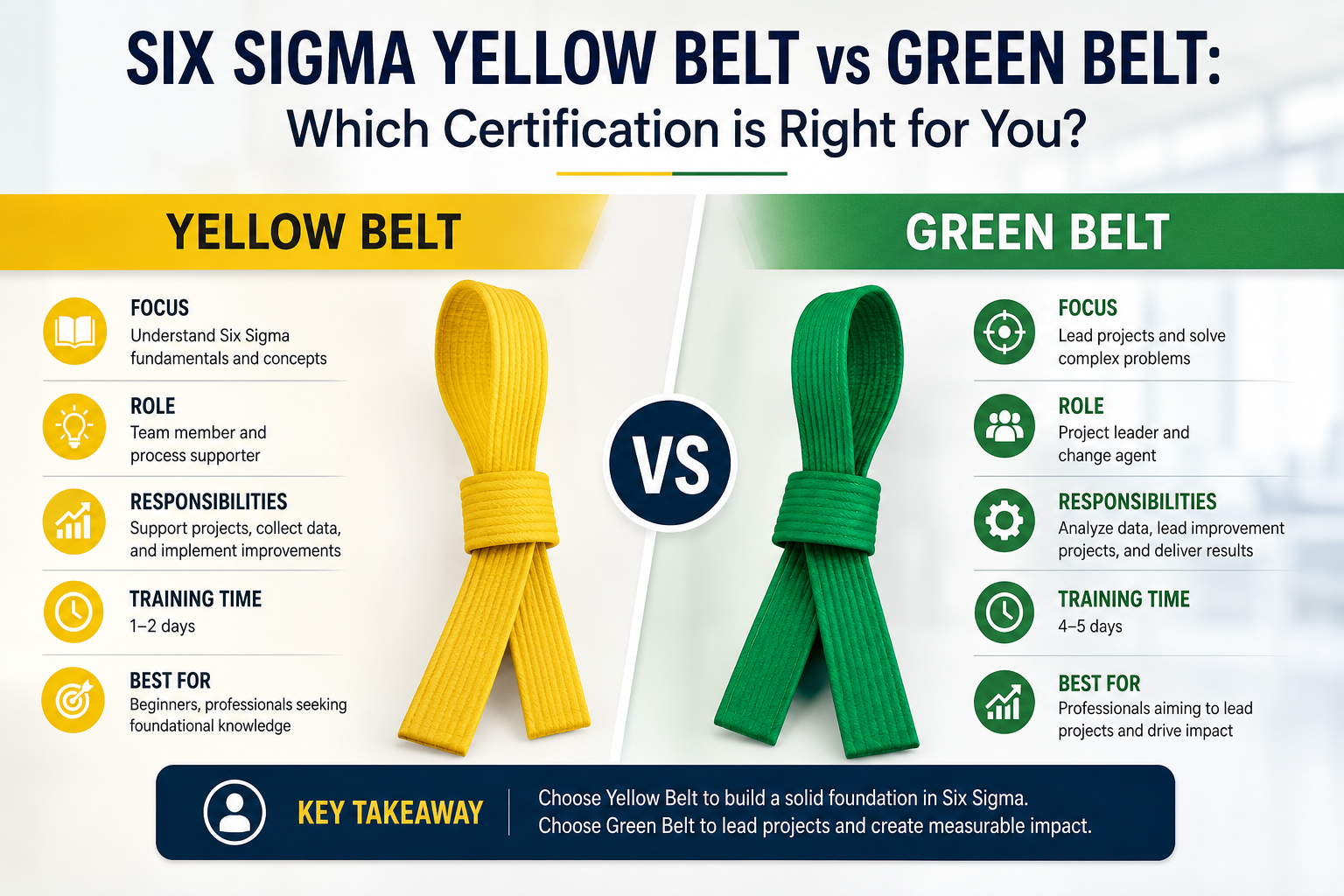
LevelSuitable ForFocus AreaWhite BeltBeginnersBasic conceptsYellow BeltTeam membersProcess participationGreen BeltProfessionalsProject executionBlack BeltLeadersAdvanced analyticsMaster Black BeltExpertsStrategy and mentoring
White Belt
White Belt introduces fundamental concepts of Six Sigma.
Topics include:
- Process improvement basics
- Quality awareness
- Overview of DMAIC Methodology
Best for:
Students and beginners.
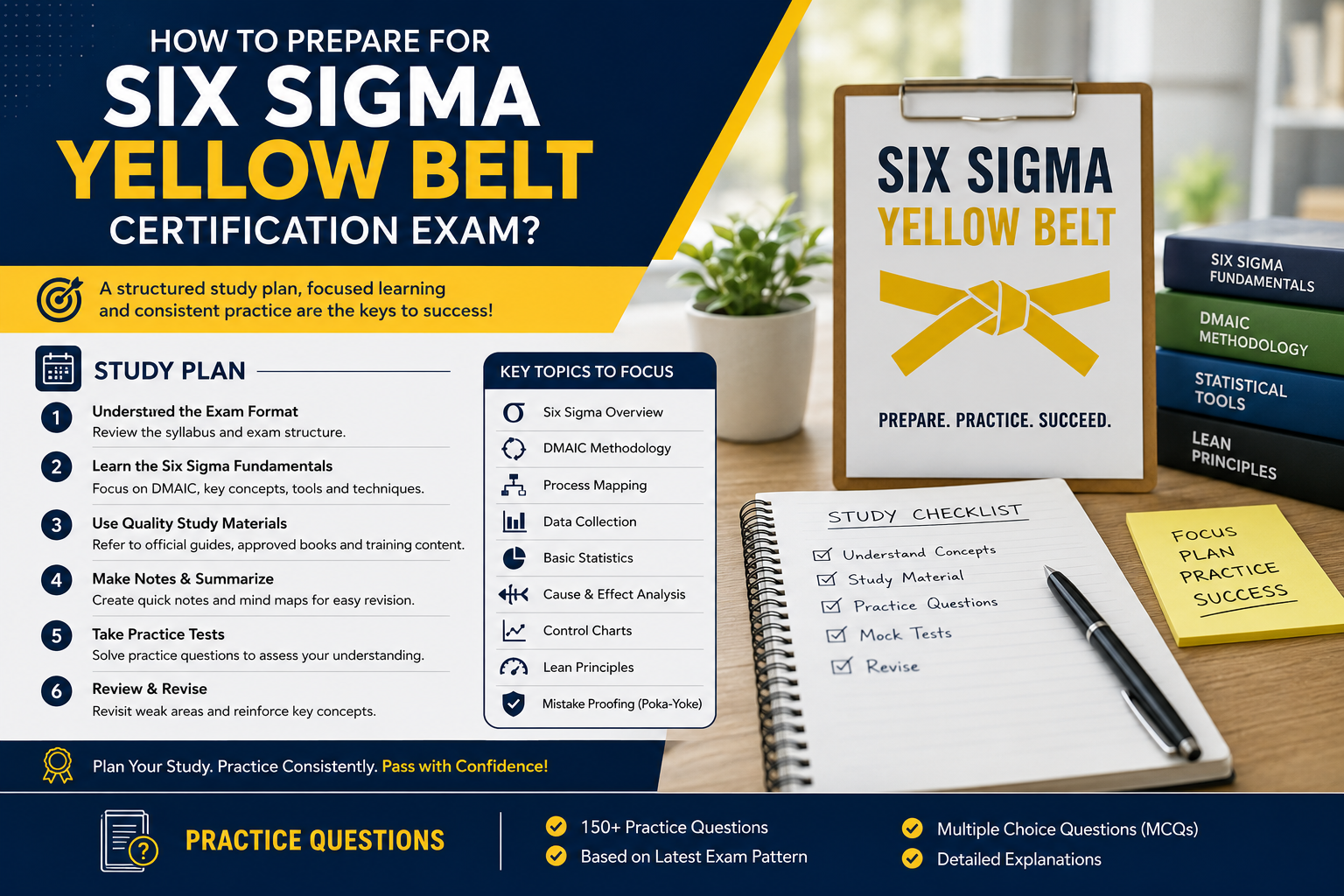
Yellow Belt
Yellow Belt professionals participate in improvement projects.
Training covers:
- Process mapping
- Problem-solving methods
- Team collaboration
Suitable for:
Operations teams and entry-level professionals.
Green Belt
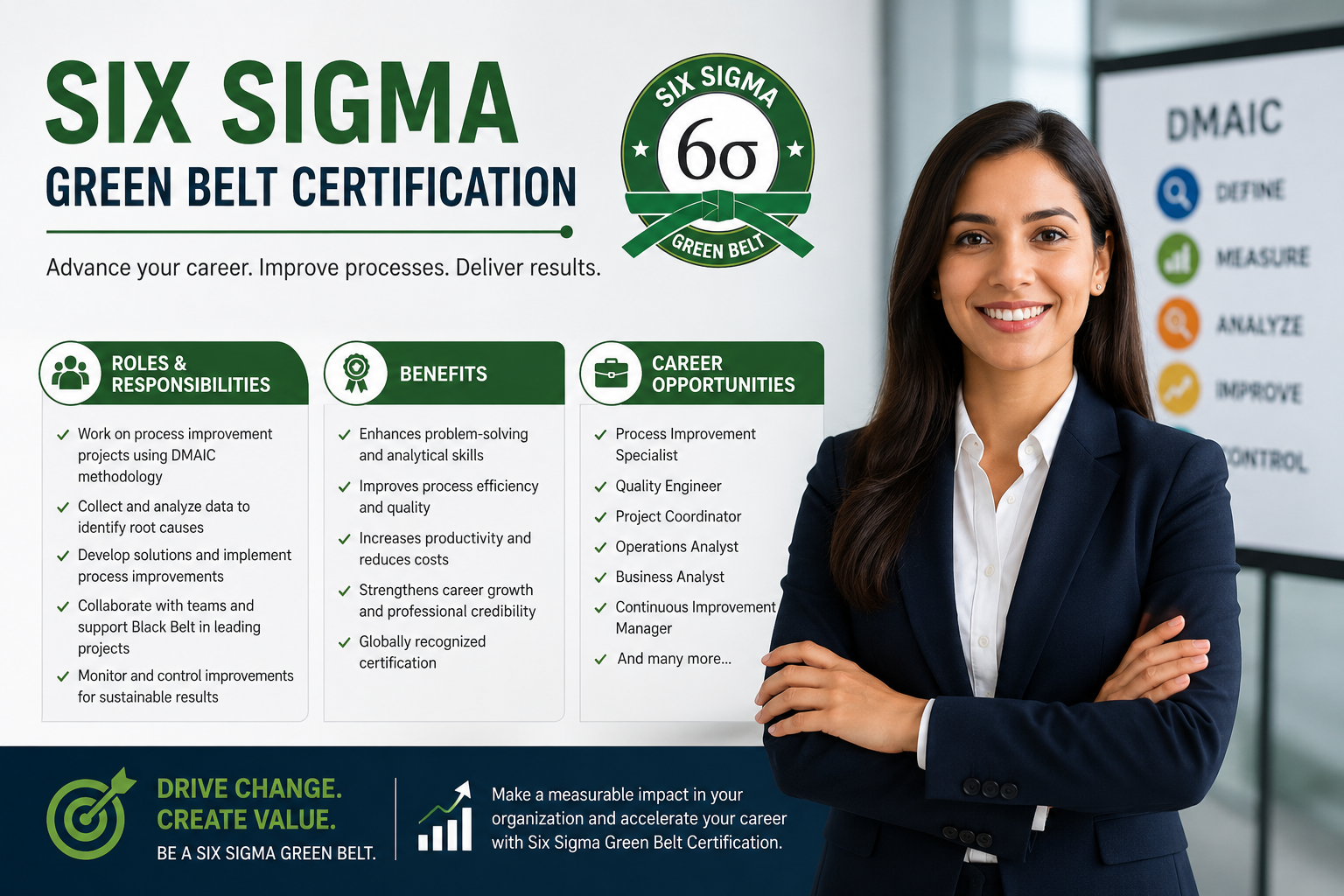
Green Belt is one of the most popular Six Sigma Certification levels.
Professionals learn:
- DMAIC implementation
- Statistical tools
- Root cause analysis
- Project management
Green Belt holders often lead small improvement initiatives.
Black Belt
Black Belt professionals handle larger transformation projects.
Skills include:
- Advanced statistics
- Leadership
- Change management
- Project execution
Black Belts frequently work with senior management.
Master Black Belt
This is the highest level.
Responsibilities include:
- Strategy development
- Training teams
- Mentoring Black Belts
- Enterprise-level improvements
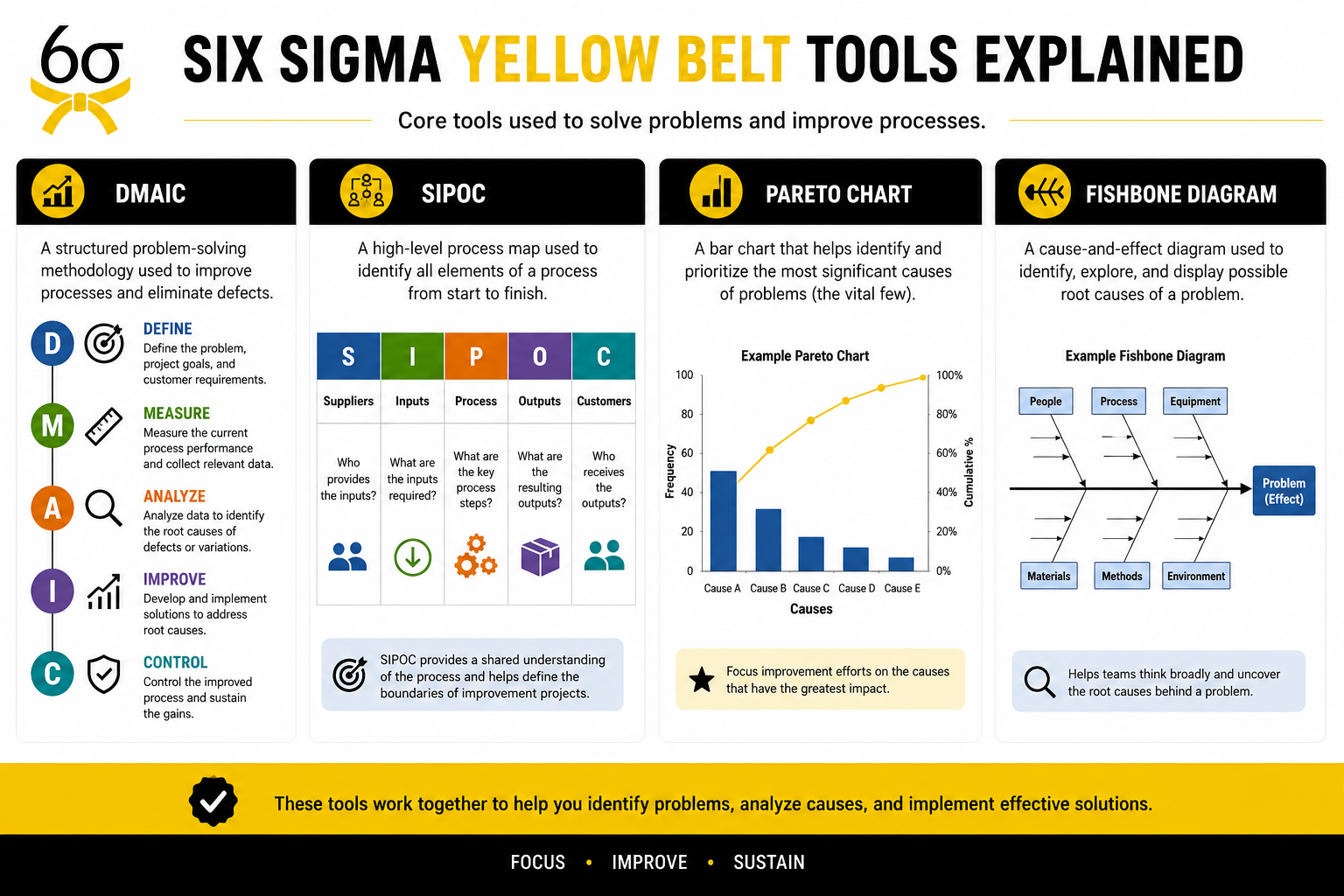
Step-by-Step Process: Understanding DMAIC Methodology
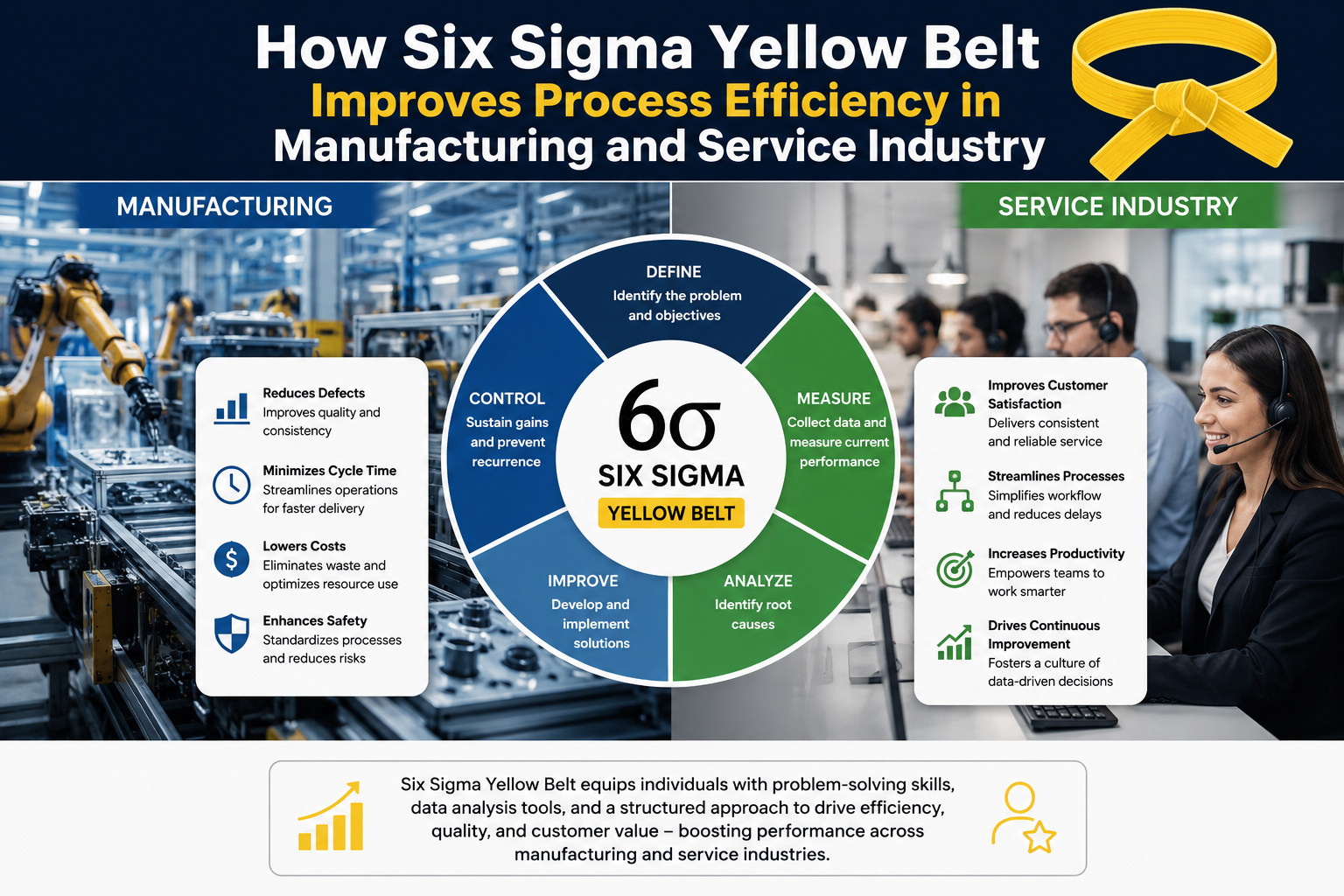
DMAIC Methodology is the foundation of Six Sigma.
DMAIC stands for:
D – Define
Identify:
- Problem statement
- Customer requirements
- Project goals
Example:
A company notices delivery delays.
Problem:
Late shipments affecting customer satisfaction.
M – Measure
Collect process data.
Questions asked:
- What is current performance?
- Where are inefficiencies?
Metrics include:
- Defect rates
- Turnaround time
- Costs
A – Analyze
Identify root causes.
Tools used:
- Fishbone Diagram
- Pareto Analysis
- Cause-and-effect mapping
Example:
Delivery delays traced to warehouse bottlenecks.
I – Improve
Implement solutions.
Actions may include:
- Process redesign
- Automation
- Workflow optimization
C – Control
Maintain improvements.
Methods:
- Monitoring KPIs
- Dashboards
- Audits
Goal:
Prevent process regression.
Real Industry Examples of Six Sigma Applications
Manufacturing Industry
Problem:
High defect rates in production.
Solution:
Six Sigma project identifies machine calibration issues.
Outcome:
Reduced defects and lower costs.
Healthcare Industry
Problem:
Long patient waiting times.
Solution:
Lean Six Sigma process redesign.
Result:
Faster service delivery.
IT Industry
Problem:
Repeated software deployment errors.
Solution:
Root cause analysis and workflow improvement.
Outcome:
Reduced incidents and improved release quality.
Logistics and Supply Chain
Problem:
Shipment delays.
Solution:
Process mapping and bottleneck elimination.
Result:
Improved delivery performance.
Tools, Frameworks and Methodologies Used in Six Sigma Training
Six Sigma Courses include various analytical tools.
Common Six Sigma Tools
ToolPurposePareto ChartPrioritize issuesFishbone DiagramRoot cause analysisControl ChartsMonitor processesSIPOC DiagramProcess mappingHistogramData distributionFMEARisk analysis
Lean Six Sigma Framework
Lean Six Sigma combines:
Lean Principles
Focus on:
- Waste reduction
- Faster workflows
- Value creation
Six Sigma Principles
Focus on:
- Quality
- Variation reduction
- Statistical control
Together they create comprehensive Process Improvement Training systems.
Who Should Take Six Sigma Training?
Six Sigma Training benefits professionals across industries.
Ideal candidates include:
Students and Fresh Graduates
Gain additional credentials before entering the workforce.
Corporate Employees
Useful for:
- Operations teams
- Quality departments
- Supply chain professionals
Managers and Leaders
Supports:
- Strategic decision making
- Process transformation
Business Owners
Helps improve profitability through Business Process Improvement initiatives.
Common Challenges in Six Sigma Implementation and Solutions
Challenge 1: Resistance to Change
Employees may resist process changes.
Solution:
Provide training and involve teams early.
Challenge 2: Lack of Leadership Support
Without management buy-in, projects struggle.
Solution:
Align Six Sigma initiatives with business objectives.
Challenge 3: Insufficient Data
Poor data quality affects analysis.
Solution:
Improve data collection systems.
Challenge 4: Unrealistic Expectations
Some organizations expect immediate results.
Solution:
Focus on continuous improvement rather than quick wins.
Career Benefits of Six Sigma Certification
Higher Employability
Recruiters value process improvement expertise.
Common job roles include:
- Quality Analyst
- Operations Manager
- Process Consultant
- Continuous Improvement Specialist
- Project Manager
Salary Growth
Professionals with Six Sigma Certification often command better compensation due to specialized skills.
Cross-Industry Relevance
Industries using Six Sigma include:
- Manufacturing
- Healthcare
- Automotive
- IT
- Banking
- Logistics
- Retail
- Education
Leadership Development
Six Sigma develops:
- Analytical thinking
- Problem-solving skills
- Project leadership
These skills remain valuable across roles.
Frequently Asked Questions (People Also Ask)
What is Six Sigma?
Six Sigma is a process improvement methodology focused on reducing defects and improving quality using data-driven techniques.
Who should take Six Sigma Training?
Students, professionals, managers, HR teams, business owners, and quality specialists can benefit from Six Sigma Training.
Is Six Sigma Certification worth it?
Yes. Six Sigma Certification improves career opportunities, enhances analytical skills, and supports business process improvement initiatives.
Which Six Sigma level is best?
Green Belt is often considered the best starting point for professionals because it balances theory and practical application.
How long does Six Sigma Training take?
Training duration varies:
- White Belt: Few hours
- Yellow Belt: 1–2 days
- Green Belt: Several weeks
- Black Belt: Few months
What industries use Six Sigma?
Manufacturing, healthcare, IT, logistics, banking, retail, automotive, and service industries widely use Six Sigma.
What is Lean Six Sigma?
Lean Six Sigma combines Lean methods for waste reduction with Six Sigma methodologies for quality improvement.
What is DMAIC Methodology?
DMAIC stands for Define, Measure, Analyze, Improve, and Control. It is the core framework used in Six Sigma projects.
Can beginners learn Six Sigma?
Yes. Beginners can start with White Belt or Yellow Belt certification programs.
Conclusion
Six Sigma Training has become much more than a quality management technique. Today, it serves as a strategic framework for operational excellence, process optimization, and business growth.
From manufacturing plants and healthcare institutions to IT organizations and service companies, Six Sigma continues to help businesses improve efficiency, reduce waste, and enhance customer satisfaction.
For professionals, Six Sigma Certification offers more than a credential. It builds practical problem-solving skills, strengthens leadership abilities, and opens career opportunities across industries.
Whether you are beginning your career or leading organizational transformation, learning Six Sigma can be a valuable investment in long-term growth.
Looking for professional Six Sigma Training and Certification? Explore expert-led programs designed to help individuals and organizations achieve operational excellence and process improvement.