About iQS

Empowering learners and educators with a comprehensive platform that bridges the gap between traditional and modern education. iQS inspires excellence in education and fosters growth for a brighter future.

Follow Us

Home Blogs
Pravin sahani
May 30, 2026
How to Prepare for Six Sigma Black Belt Certification Exam? Complete Study Plan

Are you considering taking the Six Sigma Black Belt Certification Exam? Whether you're a seasoned professional or just starting your journey in process improvement, preparing for this exam can be a daunting task. In this comprehensive guide, we’ll outline a complete study plan to help you ace the black belt certification exam and advance your career. Understanding Six Sigma and the Black Belt Certification Before diving into the preparation strategies, it's essential to understand what Six Sigma is and why the Black Belt certification holds significant value. Six Sigma is a data-driven methodology aimed at improving business processes by eliminating defects. The Black Belt certification signifies that the individual has a deep understanding of Six Sigma principles and can lead projects to drive process improvements. Why Pursue Black Belt Certification? In India, the demand for Six Sigma professionals is on the rise as organizations strive for operational excellence. Obtaining a black belt certification can enhance your career prospects, increase your earning potential, and establish you as a leader in quality management. Key Topics Covered in the Black Belt Certification Exam The Black Belt certification exam typically covers a variety of topics, including: Creating Your Study Plan for the Six Sigma Black Belt Exam Now that you understand the significance and content of the exam, let’s develop a structured study plan to ensure effective preparation. 1. Establish Your Study Timeline Determine how much time you have before the exam date. A typical study timeline spans 8 to 12 weeks, depending on your existing knowledge and experience. Break down your study plan into manageable weekly goals. 2. Gather Study Materials Collect reputable study materials that cover all exam topics comprehensively: 3. Create a Study Schedule Draft a weekly study schedule that includes: 4. Focus on Understanding Concepts Rather than rote memorization, aim to understand the underlying concepts. Use real-world examples to see how Six Sigma principles apply in various industries. This understanding will help you tackle scenario-based questions in the exam. 5. Join a Study Group Consider joining a local or online study group. Collaborating with peers can provide additional insights, clarify doubts, and keep you motivated throughout your preparation. 6. Utilize Practice Exams Practice exams are invaluable in preparing for the Six Sigma exam. They help familiarize you with the exam format and timing. Analyze your results to identify areas that need more focus. 7. Review and Revise In the final weeks leading up to the exam, prioritize review and revision. Focus on your weak areas and ensure you have a solid grasp of all key concepts. Flashcards and summary notes can be very effective during this stage. Exam Day Tips On the day of the exam, ensure you are well-rested and mentally prepared. Here are some tips: FAQs About the Six Sigma Black Belt Certification Exam Q1: What is the passing score for the Six Sigma Black Belt exam? A1: Most certification bodies require a passing score of around 70% to 80%, but this may vary, so check the specific requirements of the certifying organization. Q2: How long is the Six Sigma Black Belt exam? A2: The exam duration typically ranges from 3 to 4 hours, depending on the certification body. Q3: Can I take the exam online? A3: Yes, many certification providers offer online testing options. Ensure that you check the details and requirements for online exams. Q4: How often do I need to renew my certification? A4: Renewal requirements vary by certifying organization, but most require recertification every 3 to 5 years. Conclusion Preparing for the Six Sigma Black Belt Certification Exam requires dedication and a structured approach. By following the study plan outlined in this guide, you’ll be well-equipped to tackle the exam and achieve your certification goals. Remember, the journey to becoming a Black Belt is not just about passing an exam; it’s about mastering the skills that will make you a leader in quality management. Ready to take the next step in your career? Start your black belt preparation today! Explore our recommended resources and courses to kickstart your Six Sigma journey.

Pravin sahani
May 30, 2026
Six Sigma Black Belt Project Examples and Real Industry Case Studies

Six Sigma has emerged as a powerful methodology for improving processes, reducing defects, and enhancing productivity across various industries. As professionals seek to leverage the principles of Six Sigma, understanding the practical applications through Six Sigma Black Belt project examples and real-world case studies becomes essential. In this blog, we will explore notable Black Belt project case studies to illustrate the effectiveness of Six Sigma in driving process improvement projects. Understanding Six Sigma and the Role of Black Belts Six Sigma is a data-driven approach aimed at eliminating defects in any process, whether in manufacturing, service, or any other industry. The methodology employs statistical tools and techniques to identify variations and implement solutions. The role of a Black Belt is pivotal in this process, as these professionals lead project teams, mentor Green Belts, and drive continuous improvement initiatives. What is a Six Sigma Black Belt? A Six Sigma Black Belt is a trained professional equipped with the knowledge of Six Sigma principles and methodologies. They possess a deep understanding of statistical analysis, project management, and team dynamics. Black Belts are responsible for leading complex projects that require rigorous data analysis and strategic planning. Their work is critical in achieving significant improvements in quality and efficiency. Six Sigma Black Belt Project Examples Let’s dive into some compelling Six Sigma Black Belt project examples that highlight the methodology's effectiveness across various industries. 1. Manufacturing: Reducing Scrap in a Production Line A leading automobile manufacturer in India faced substantial losses due to high scrap rates in their production line. A Black Belt was assigned to lead a project aimed at reducing scrap by 20% over six months. Using the DMAIC (Define, Measure, Analyze, Improve, Control) framework, the team defined the problem and measured current scrap rates. They analyzed the root causes using tools like Fishbone diagrams and Pareto charts. The team identified that improper machine calibration was a significant contributor to the issue. By implementing a new calibration schedule and training the operators, they achieved a 25% reduction in scrap, translating into significant cost savings and improved overall efficiency. 2. Healthcare: Improving Patient Flow in a Hospital In a busy metropolitan hospital, patient wait times in the emergency department were exceeding acceptable limits. A Six Sigma Black Belt was tasked with identifying bottlenecks and improving patient flow. Through process mapping and data analysis, the team discovered that triage procedures were causing delays. A new protocol was developed that streamlined the triage process by introducing a fast-track system for less critical patients. The outcome was remarkable; patient wait times decreased by 40%, leading to enhanced patient satisfaction and better utilization of hospital resources. 3. Service Industry: Enhancing Customer Satisfaction in a Telecom Company A major telecom service provider in India experienced declining customer satisfaction scores due to long response times in their customer service department. A Black Belt initiated a project to improve response times and overall customer service quality. By analyzing customer feedback and service metrics, the team identified key areas for improvement. They implemented a new call routing system and enhanced training for customer service representatives. As a result, average response times improved by 30%, and customer satisfaction scores rose significantly, demonstrating the impact of process improvement projects in the service sector. 4. Retail: Optimizing Inventory Management A large retail chain faced challenges with excess inventory and stockouts, leading to lost sales and increased holding costs. A Black Belt was brought in to optimize inventory management processes. The project team utilized inventory turnover metrics and conducted a root cause analysis to understand demand variability. They implemented a Just-In-Time (JIT) inventory system, which allowed the retailer to reduce excess stock while ensuring product availability. The results were impressive; inventory holding costs dropped by 20%, and sales increased by 15% due to improved product availability. This case study exemplifies how Six Sigma can drive efficiency in retail operations. 5. IT Sector: Reducing Software Defects In the rapidly evolving IT sector, a software development company faced significant challenges with product defects and delays in delivery. A Black Belt was assigned to lead a project focused on reducing defects in their software products. The team employed statistical process control (SPC) to monitor defect rates throughout the development cycle. They implemented Agile methodologies combined with Six Sigma principles to enhance collaboration and communication among teams. As a result, software defects were reduced by 50%, and project delivery times improved by 30%, showcasing the potential of Six Sigma in tech-driven environments. Real-World Industry Case Studies The following Six Sigma case studies highlight how various industries successfully applied Six Sigma principles to achieve remarkable results. 1. General Electric (GE) General Electric is one of the most prominent advocates of Six Sigma. In the 1990s, GE implemented Six Sigma across its operations, leading to an estimated savings of $12 billion. One notable project focused on reducing defects in the manufacturing process of jet engines. By standardizing processes and enhancing quality control, GE achieved a 99.9% defect-free rate, significantly improving product reliability. 2. Ford Motor Company Ford adopted Six Sigma to address quality issues in its production lines. A specific project aimed at reducing warranty claims led to the identification of key process inefficiencies. By implementing Six Sigma methodologies, Ford improved its quality metrics and reduced warranty costs by millions of dollars annually, reinforcing the importance of process improvement in manufacturing. 3. Motorola Motorola is credited with pioneering Six Sigma in the 1980s. One of its landmark projects involved improving the yield of semiconductor manufacturing processes. Through rigorous data analysis and process optimization, Motorola achieved a dramatic increase in yield rates, which not only reduced costs but also enhanced product quality, solidifying its competitive edge in the market. FAQs about Six Sigma Black Belt Projects What are the key roles of a Six Sigma Black Belt? A Six Sigma Black Belt leads project teams, mentors Green Belts, conducts data analysis, and implements process improvement initiatives. They are responsible for ensuring projects align with organizational goals and deliver measurable results. How long does it take to complete a Six Sigma Black Belt project? The duration of a Six Sigma Black Belt project can vary depending on the complexity of the issue being addressed. Typically, projects can range from a few months to over a year. The DMAIC framework helps in systematically addressing problems within a structured timeframe. Can Six Sigma be applied to service industries? Absolutely! Six Sigma is highly applicable in service industries such as healthcare, finance, and telecommunications. The methodology focuses on process improvement, which is essential for enhancing service delivery and customer satisfaction. What tools are commonly used in Six Sigma projects? Common tools include process mapping, Pareto analysis, Fishbone diagrams, control charts, and statistical analysis software. These tools help in identifying root causes, measuring performance, and monitoring improvements. Conclusion Six Sigma Black Belt projects have proven to be instrumental in driving process improvements across diverse industries. The case studies discussed in this blog highlight the versatility and effectiveness of the Six Sigma methodology in achieving significant operational enhancements. By leveraging these Six Sigma Black Belt project examples, organizations can embark on their journey toward excellence, ensuring sustained growth and customer satisfaction. If you're considering implementing Six Sigma in your organization, now is the time to take action. Contact us today to learn how our Six Sigma training and consultancy services can help you achieve your process improvement goals!

Pravin sahani
May 30, 2026
Advanced Six Sigma Black Belt Tools and Techniques for Process Improvement

In the competitive landscape of Indian industries, the quest for excellence is ongoing. One of the most effective methodologies to achieve operational excellence is Six Sigma, particularly for those who are well-versed in the Black Belt methodology. With a deep understanding of advanced Six Sigma tools, Black Belt professionals can significantly enhance process improvement initiatives. In this article, we will explore the advanced Six Sigma Black Belt tools and techniques that are essential for driving process excellence. Understanding Six Sigma and Black Belt Methodology Six Sigma is a data-driven approach aimed at reducing defects and improving quality in processes. The methodology revolves around a systematic process of defining, measuring, analyzing, improving, and controlling (DMAIC) processes. The Black Belt level signifies an advanced understanding of Six Sigma principles, equipping individuals to lead projects and mentor teams. Key Advanced Six Sigma Tools To truly excel in the Black Belt role, familiarity with advanced Six Sigma tools is crucial. Below are some key tools that every Six Sigma Black Belt should master: 1. Design of Experiments (DOE) Design of Experiments (DOE) is an indispensable tool in the arsenal of Six Sigma Black Belts. It allows professionals to plan, conduct, and analyze controlled tests to evaluate the factors that influence a process. By understanding the relationship between different variables, Black Belts can optimize processes effectively. 2. Statistical Process Control (SPC) Statistical Process Control (SPC) involves the use of statistical methods to monitor and control processes. By utilizing control charts, Six Sigma professionals can detect variations in processes and ensure that they operate within specified limits. This proactive approach helps in maintaining quality and consistency. 3. Failure Mode and Effects Analysis (FMEA) FMEA is a systematic method for evaluating potential failure modes within a system. By identifying the possible failures and their impacts, Black Belts can prioritize risks and implement corrective actions before issues arise. This preventive approach is vital for ensuring long-term process reliability. 4. Lean Tools Integrating Lean principles with Six Sigma can yield substantial benefits. Tools like Value Stream Mapping (VSM) and 5S can help identify waste and streamline processes. Lean tools complement Six Sigma methodologies by focusing on efficiency and waste reduction, thereby enhancing overall productivity. 5. Root Cause Analysis (RCA) Root Cause Analysis is crucial for identifying the underlying causes of defects or problems. Techniques like the 5 Whys and Fishbone diagram help Black Belts dissect issues methodically. By addressing root causes rather than symptoms, organizations can achieve sustainable improvements. Implementing Advanced Six Sigma Techniques With the right tools in hand, the next step is effective implementation. Here are some strategies to consider: 1. Data-Driven Decision Making At the heart of Six Sigma is data. Advanced Six Sigma Black Belts must harness data analytics to drive decision-making. Utilizing software tools for data analysis can help in identifying trends and making informed choices that lead to process improvements. 2. Continuous Training and Development The world of Six Sigma is ever-evolving. Continuous training and development for teams are essential to stay updated with the latest advancements in Six Sigma tools. Conducting workshops and mentoring sessions can foster a culture of learning and improvement within the organization. 3. Cross-Functional Collaboration Encouraging collaboration between departments can lead to more holistic process improvements. By involving different teams in Six Sigma initiatives, organizations can leverage diverse perspectives and expertise, resulting in more effective solutions. Case Studies of Successful Six Sigma Implementations Understanding how advanced Six Sigma tools have been successfully applied can provide valuable insights. Here are a few examples from Indian industries: 1. Manufacturing Sector A leading automobile manufacturer implemented DOE to optimize their production line. By identifying and controlling key variables, they were able to reduce defects by 30% within six months, resulting in significant cost savings and improved customer satisfaction. 2. Healthcare Industry A healthcare provider adopted SPC to monitor patient care processes. By analyzing data from control charts, they identified bottlenecks in service delivery, leading to a 20% reduction in patient waiting times, ultimately enhancing patient experience. FAQs about Advanced Six Sigma Black Belt Tools What is the importance of advanced Six Sigma tools in process improvement? Advanced Six Sigma tools provide Black Belts with the methodologies and techniques necessary to identify inefficiencies, reduce variation, and improve overall quality in processes, leading to enhanced operational performance. How can I become a Six Sigma Black Belt? To become a Six Sigma Black Belt, you typically need to complete formal training, pass a certification exam, and gain experience working on Six Sigma projects. Many organizations offer training programs tailored for aspiring Black Belts. Can Six Sigma methodologies be applied to service industries? Absolutely! Six Sigma methodologies are highly applicable in service industries. Tools like FMEA and process mapping can help identify inefficiencies and improve service quality, just as they do in manufacturing settings. Conclusion Mastering advanced Six Sigma Black Belt tools is essential for driving process improvement in today's competitive environment. By leveraging these tools and techniques, professionals can lead their organizations towards excellence, ensuring sustained growth and customer satisfaction. If you're looking to enhance your skills in Six Sigma or implement these methodologies in your organization, consider enrolling in a certified Six Sigma training program to kickstart your journey. Call to Action Are you ready to take your Six Sigma skills to the next level? Join our comprehensive Six Sigma Black Belt training program today and unlock the potential for significant process improvements in your organization. Contact us now for more details!

Pravin sahani
May 30, 2026
Six Sigma Black Belt vs Master Black Belt: Key Differences and Career Path

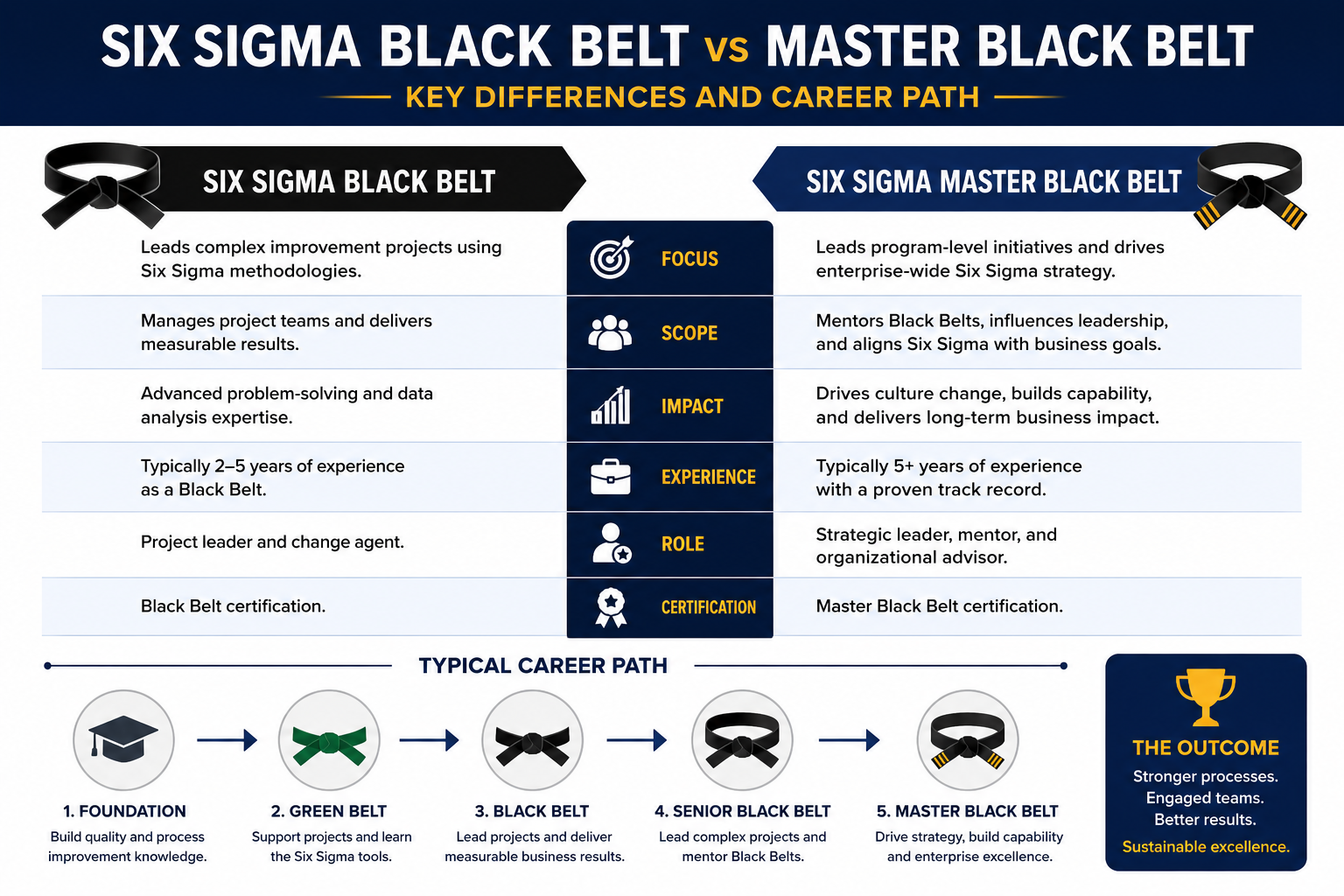
In today's competitive business landscape, organizations are constantly seeking ways to improve processes, increase efficiency, and enhance quality. Six Sigma has emerged as a leading methodology for achieving these objectives. Within this framework, the roles of Six Sigma Black Belt and Master Black Belt are crucial. However, many professionals often find themselves confused about the black belt vs master black belt distinction. In this blog, we will delve into the key differences between these two certification levels and explore the career paths available for each. Understanding Six Sigma Certifications Six Sigma is a data-driven approach that focuses on process improvement by identifying and eliminating defects. It is widely adopted across industries in India, from manufacturing to IT services, and is essential for professionals aiming for operational excellence. The Six Sigma certification levels include: What is a Six Sigma Black Belt? A Six Sigma Black Belt is a professional who has a deep understanding of Six Sigma principles and is skilled in leading project teams. They are responsible for implementing Six Sigma methodologies in their organizations and are often involved in mentoring Green Belts and Yellow Belts. Black Belts typically dedicate a significant portion of their time to projects aimed at improving quality and reducing costs. Key Responsibilities of a Black Belt Skills Required for a Six Sigma Black Belt To excel as a Black Belt, individuals should possess the following skills: What is a Master Black Belt? A Master Black Belt is the highest level of Six Sigma certification. These professionals have extensive experience in Six Sigma methodologies and are responsible for strategic implementation within their organizations. They play a critical role in mentoring both Black Belts and Green Belts and are often involved in training programs. Key Responsibilities of a Master Black Belt Skills Required for a Master Black Belt Master Black Belts should possess advanced skills, including: Black Belt vs Master Black Belt: Key Differences Now that we have a clear understanding of what Black Belts and Master Black Belts do, let's highlight the key differences between them: Career Path for Six Sigma Professionals in India The career path for Six Sigma professionals can be rewarding, especially in a growing economy like India. Here’s a typical progression: As you progress, you may also explore roles such as Six Sigma Consultant, Quality Manager, or operations leader, which can further enhance your career prospects. FAQs about Six Sigma Certifications 1. What is the duration of Six Sigma Black Belt and Master Black Belt certifications? The duration varies by program, but typically, Black Belt courses last 3 to 6 months, while Master Black Belt courses may take 6 months to a year. 2. Is Six Sigma certification necessary for career advancement? While not mandatory, Six Sigma certification can significantly enhance your resume and career prospects in quality management and process improvement. 3. Can I pursue both Black Belt and Master Black Belt certifications simultaneously? It is generally recommended to complete the Black Belt certification before pursuing Master Black Belt certification to build the necessary knowledge and experience. 4. How much can I earn as a Six Sigma Black Belt or Master Black Belt in India? On average, a Six Sigma Black Belt can earn between ₹6 to ₹10 lakhs per annum, while Master Black Belts can command salaries upwards of ₹10 lakhs, depending on the industry and experience. 5. Where can I find Six Sigma certification programs in India? There are numerous institutes and online platforms offering Six Sigma certification programs in India, including renowned institutions like ASQ, IIMs, and various online learning platforms. Conclusion Understanding the differences between black belt vs master black belt is crucial for anyone looking to advance their career in Six Sigma. Both certifications offer unique opportunities and responsibilities, and choosing the right path can significantly impact your professional growth. Whether you aim to lead projects as a Black Belt or drive strategic initiatives as a Master Black Belt, investing in Six Sigma certification can be a game-changer in your career. Are you ready to take the next step in your Six Sigma journey? Contact us today to learn more about our Six Sigma certification programs and how they can propel your career forward!

Pravin sahani
May 29, 2026
What is Six Sigma Black Belt Certification? Roles, Responsibilities & Career Growth

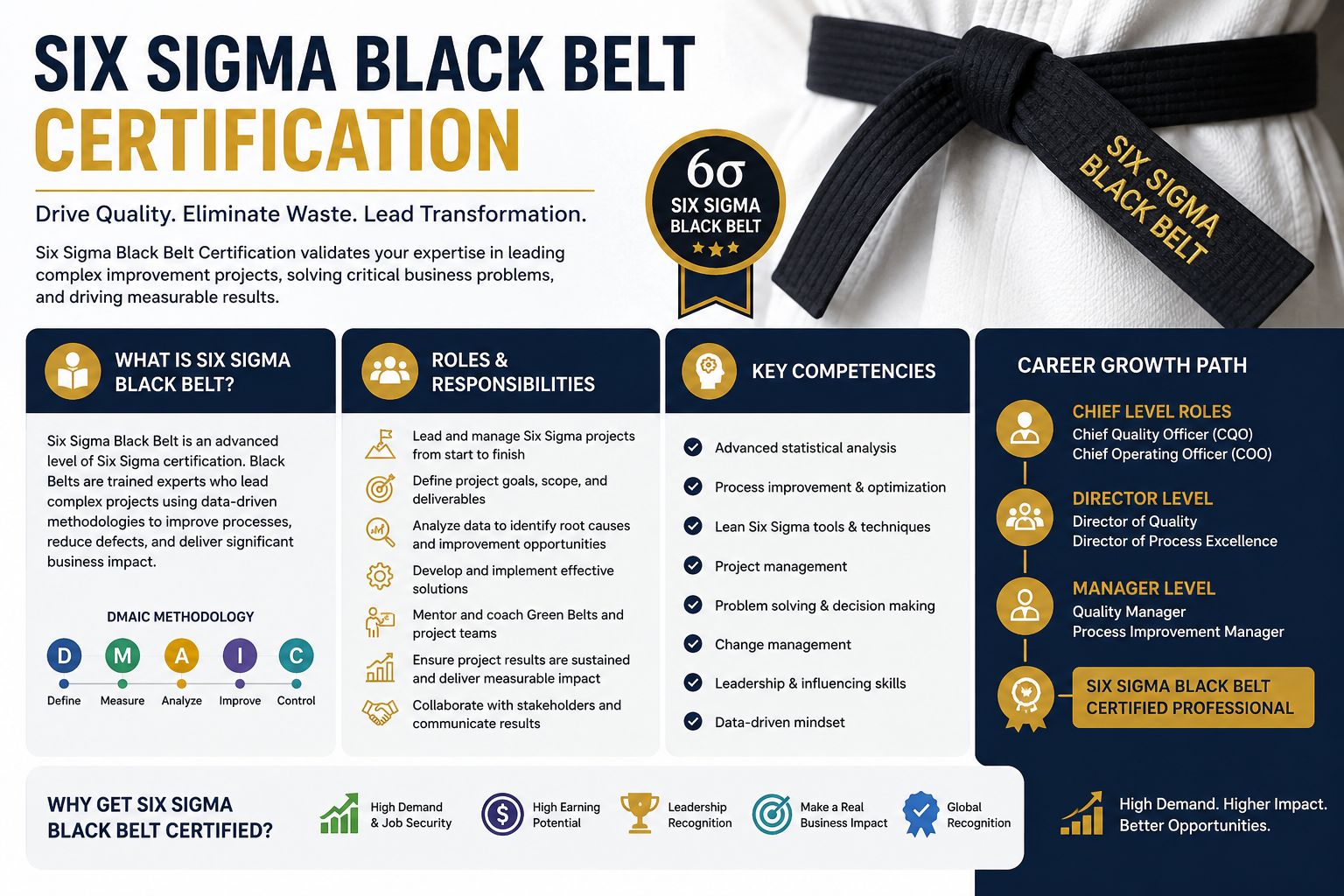
In today's competitive business environment, organizations are constantly seeking ways to improve their processes, reduce waste, and enhance customer satisfaction. One of the most effective methodologies for achieving these goals is Six Sigma. Among its various levels, the Six Sigma Black Belt Certification stands out as a prestigious qualification that equips professionals with the skills needed to lead quality improvement projects. In this blog, we will delve into what Six Sigma Black Belt certification entails, the roles and responsibilities associated with it, and the promising career growth opportunities it offers in India. Understanding Six Sigma and Black Belt Certification Six Sigma is a data-driven methodology that aims to eliminate defects in any process, whether in manufacturing or service delivery. It uses statistical tools and techniques to analyze and improve processes, ultimately leading to increased efficiency and customer satisfaction. The Six Sigma methodology is structured around five key phases: Define, Measure, Analyze, Improve, and Control (DMAIC). The Six Sigma Black Belt Certification is a professional credential awarded to individuals who have demonstrated a thorough understanding of Six Sigma principles and can lead complex projects. Black Belts are expected to possess advanced knowledge of statistical analysis, project management, and leadership skills, enabling them to drive process improvements effectively. Roles and Responsibilities of a Six Sigma Black Belt As a Six Sigma Black Belt, your role extends beyond just understanding the tools and techniques of Six Sigma. Here are some of the key responsibilities: 1. Leading Improvement Projects A Black Belt is responsible for leading cross-functional teams in improvement projects. They define project goals, develop project plans, and ensure that project deliverables are met on time and within budget. 2. Data Collection and Analysis Data is at the heart of Six Sigma. Black Belts are responsible for collecting and analyzing data to identify process inefficiencies and defects. They use various statistical tools to interpret data and derive actionable insights. 3. Mentoring Green Belts In addition to leading projects, Black Belts often mentor Green Belts, who are typically less experienced in Six Sigma methodologies. This mentorship involves guiding them through their projects and helping them develop their skills. 4. Training and Development Black Belts frequently conduct training sessions for team members and other stakeholders to instill a culture of continuous improvement within the organization. 5. Stakeholder Engagement Effective communication with stakeholders is crucial. Black Belts must engage with various departments to ensure alignment on project goals and gather support for initiatives. How to Obtain Six Sigma Black Belt Certification To achieve the Six Sigma Black Belt Certification, candidates typically need to follow these steps: 1. Prerequisites While specific prerequisites may vary by certifying body, candidates are generally expected to have a basic understanding of Six Sigma concepts, often acquired through Six Sigma Black Belt training or prior experience. 2. Training Program Enrolling in a reputable training program is essential. Many institutes in India offer Six Sigma Black Belt courses that cover advanced statistical tools, project management, and team dynamics. 3. Examination After completing the training, candidates must pass a rigorous examination that tests their knowledge and understanding of Six Sigma principles and practices. 4. Practical Experience Most certification bodies require candidates to demonstrate practical experience by leading or participating in Six Sigma projects. This hands-on experience is crucial for applying theoretical knowledge to real-world situations. Career Growth Opportunities with Six Sigma Black Belt Certification A Black Belt certification opens up numerous career advancement opportunities across various industries. Here are some of the potential career paths: 1. Quality Manager As a Quality Manager, you will be responsible for overseeing quality assurance processes and ensuring compliance with industry standards. Your expertise in Six Sigma will be invaluable in this role. 2. Process Improvement Consultant Many companies seek consultants with Six Sigma expertise to help them identify inefficiencies and implement process improvements. This role often involves working with multiple clients across different industries. 3. Operations Manager Operations Managers focus on optimizing processes and ensuring that operations run smoothly. A Black Belt certification provides the skills needed to implement effective strategies for operational excellence. 4. Project Manager Project Managers are responsible for planning, executing, and closing projects. With a Black Belt certification, you can lead projects focused on quality improvement and process efficiency. 5. Continuous Improvement Manager In this role, you will be tasked with creating and implementing strategies for continuous improvement within the organization. Your Six Sigma training will help you identify areas for enhancement. FAQs About Six Sigma Black Belt Certification 1. What is the duration of Six Sigma Black Belt training? The duration of Six Sigma Black Belt training programs can vary, typically ranging from a few weeks to several months, depending on the institute and the format of the course (online or in-person). 2. Is Six Sigma Black Belt certification recognized globally? Yes, Six Sigma Black Belt certification is recognized worldwide. Various organizations and institutes offer certification, and many companies value this qualification when hiring for quality management positions. 3. Can I pursue Six Sigma Black Belt certification online? Absolutely! Many reputable organizations offer online Six Sigma Black Belt training and certification programs, making it accessible for professionals across India and beyond. 4. What is the average salary for a Six Sigma Black Belt in India? The average salary for a Six Sigma Black Belt in India varies by industry and experience level but typically ranges from ₹8 to ₹20 lakhs per annum, with potential for higher earnings in senior roles. 5. Do I need to have a specific educational background to pursue Six Sigma Black Belt certification? While a technical or engineering background can be beneficial, it is not mandatory. Candidates from various educational backgrounds can pursue Six Sigma Black Belt certification, provided they have a basic understanding of quality management principles. Conclusion The Six Sigma Black Belt certification is a valuable asset for professionals looking to enhance their career in quality management and process improvement. With the skills gained through training and practical experience, Black Belts play a crucial role in driving organizational excellence. If you are considering a career in this field, investing in Six Sigma Black Belt training can provide you with the knowledge and credentials to advance your career significantly. Ready to take your career to the next level? Explore our Six Sigma Black Belt certification courses today and become a leader in quality improvement!

Pravin sahani
May 29, 2026
How to Prepare for Six Sigma Green Belt Certification Exam? Complete Study Guide

In today’s competitive business landscape, organizations are increasingly focusing on quality improvement and process optimization. One of the most recognized methodologies for achieving these goals is Six Sigma. If you're aiming to enhance your career prospects and contribute to organizational excellence, obtaining your Six Sigma Green Belt Certification is a significant step. This comprehensive guide will walk you through effective strategies, resources, and tips for preparing for the Six Sigma Green Belt Exam. Understanding the Six Sigma Green Belt Certification The Six Sigma Green Belt Certification is designed for professionals who want to deepen their knowledge of Six Sigma principles and tools. Green Belts typically work on process improvement projects and assist Black Belts in implementing Six Sigma methodologies. This certification not only strengthens your resume but also equips you with the skills needed to drive quality improvements within your organization. Why Pursue a Six Sigma Green Belt Certification? Steps to Prepare for the Six Sigma Green Belt Certification Exam 1. Understand the Exam Structure Before diving into preparation, it is essential to understand the structure of the Green Belt Certification Exam. The exam typically consists of multiple-choice questions that test your knowledge of: Familiarize yourself with the exam format and the number of questions to better manage your time during the test. 2. Create a Study Plan Developing a structured study plan will help you cover all necessary topics systematically. Allocate specific time slots for each subject area, and ensure you stick to this schedule. A well-organized plan will enhance your Green Belt preparation and help you retain information better. 3. Gather Study Materials Utilize a combination of textbooks, online resources, and study guides. Some recommended resources include: 4. Join a Study Group Connecting with peers who are also preparing for the Six Sigma exam can be beneficial. Study groups provide motivation and an opportunity to discuss complex topics. You can share insights, quiz each other, and clarify doubts in a collaborative environment. 5. Focus on Key Topics While preparing, pay special attention to the following key areas: 6. Practice, Practice, Practice Regular practice is crucial for success. Solve as many practice questions as possible. This will not only test your knowledge but also help you manage your time during the actual exam. Identify your weak areas and focus on improving them through additional study. 7. Take Mock Exams Mock exams simulate the actual testing environment and help build your confidence. They allow you to evaluate your readiness and identify areas where you need more focus. Aim to complete at least two or three mock exams before the actual exam date. 8. Time Management During the exam, time management is critical. Practice pacing yourself so that you can complete all questions within the allotted time. Prioritize questions based on your confidence level and spend more time on challenging ones. 9. Stay Healthy and Manage Stress Don’t underestimate the importance of maintaining good health during your preparation. A balanced diet, regular exercise, and sufficient sleep can significantly enhance your cognitive functions and reduce stress levels. Incorporate relaxation techniques like meditation or yoga into your routine to stay calm and focused. Common FAQs about Six Sigma Green Belt Certification 1. What is the passing score for the Six Sigma Green Belt exam? The passing score varies by certification body, but generally, a score of 70% or higher is considered satisfactory. 2. How long does the certification last? The Six Sigma Green Belt certification does not expire, but it’s advisable to stay updated with the latest Six Sigma practices and methodologies. 3. Can I take the exam online? Many certification bodies offer online testing options. Check with your chosen institution for the specifics. 4. What are the prerequisites for taking the exam? While there are no strict prerequisites, having a basic understanding of statistics and business processes can be beneficial. Final Thoughts Preparing for the Six Sigma Green Belt Certification Exam may seem daunting, but with a solid study plan, the right resources, and a focused approach, you can increase your chances of success. Remember to practice regularly, engage with fellow learners, and maintain a healthy lifestyle throughout your preparation journey. Are you ready to kickstart your Six Sigma journey? Start your preparation today and take the first step toward becoming a certified Green Belt! Call to Action If you found this guide helpful, share it with your friends and colleagues who are also considering the Six Sigma Green Belt Certification. For more articles, tips, and resources on Six Sigma and quality management, subscribe to our newsletter!

Pravin sahani
May 29, 2026
Six Sigma Green Belt Project Examples with Real Industry Case Studies

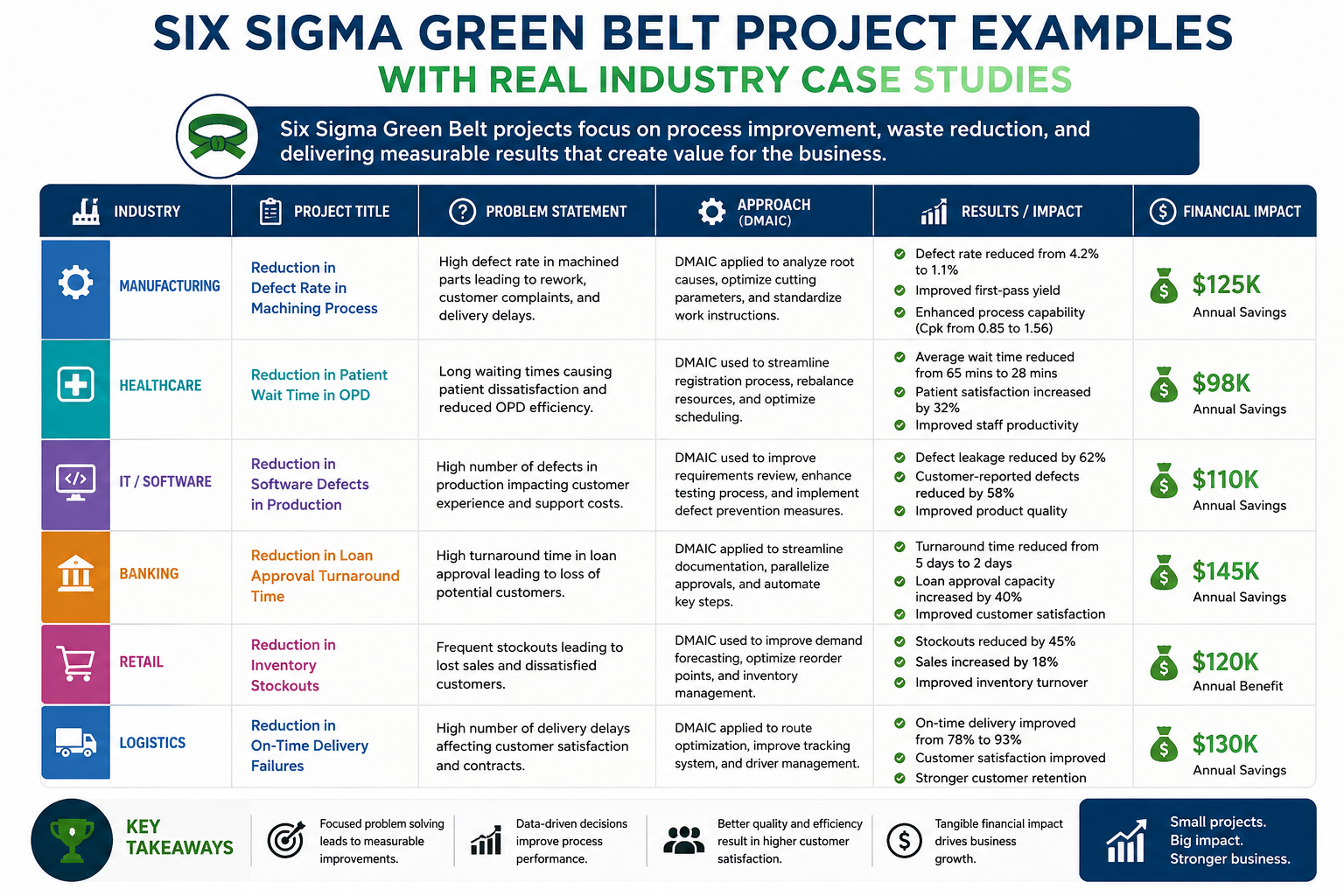
In today's competitive business landscape, organizations are constantly looking for ways to enhance efficiency, improve quality, and reduce costs. One of the most effective methodologies for achieving these goals is Six Sigma, particularly through the role of a Green Belt. In this blog, we'll explore compelling Six Sigma Green Belt project examples, showcase real industry case studies, and provide innovative Green Belt project ideas that can transform operations. Understanding Six Sigma and the Role of Green Belts Six Sigma is a data-driven methodology aimed at eliminating defects in processes and improving overall quality. Within this framework, Green Belts play a crucial role. They are typically professionals who work on process improvement projects while maintaining their primary job responsibilities. Equipped with Six Sigma training, Green Belts apply statistical tools and techniques to identify problems, analyze data, and implement solutions. Why Focus on Six Sigma Green Belt Projects? Focusing on process improvement projects under Six Sigma can lead to significant benefits, including: In India, industries ranging from manufacturing to healthcare are increasingly adopting Six Sigma methodologies, making understanding Green Belt projects essential for professionals seeking to make impactful changes. Six Sigma Green Belt Project Examples 1. Reducing Defects in Manufacturing Industry: Automotive Manufacturing Project Overview: A leading automotive manufacturer faced quality issues, with defect rates exceeding acceptable thresholds. The Green Belt team initiated a Six Sigma project using the DMAIC (Define, Measure, Analyze, Improve, Control) framework. Key Actions: Results: The project resulted in a 30% reduction in defects, leading to increased production efficiency and a substantial drop in rework costs. 2. Streamlining Patient Flow in Healthcare Industry: Healthcare Project Overview: A hospital in Mumbai sought to optimize patient flow in the emergency department to reduce wait times and enhance service delivery. Key Actions: Results: The hospital experienced a 25% decrease in average wait times and improved patient satisfaction scores. 3. Enhancing Customer Service Efficiency Industry: Retail Project Overview: A retail chain in India wanted to improve its customer service response times to foster better customer relationships. Key Actions: Results: The initiative led to a 40% reduction in response times and an increase in customer satisfaction ratings. 4. Optimizing Supply Chain Logistics Industry: E-commerce Project Overview: An e-commerce company aimed to streamline its supply chain logistics to improve delivery times and reduce shipping costs. Key Actions: Results: The company achieved a 20% reduction in shipping costs and improved delivery times by 15%. Innovative Green Belt Project Ideas For professionals looking to initiate Six Sigma Green Belt project examples, here are some innovative project ideas: Conclusion Six Sigma Green Belt projects are powerful tools for driving process improvement across diverse industries. By leveraging the DMAIC framework and focusing on data-driven decision-making, organizations can achieve remarkable results. The examples and ideas shared in this blog highlight the potential of Six Sigma in transforming operations, enhancing quality, and boosting customer satisfaction. FAQs What is a Six Sigma Green Belt? A Six Sigma Green Belt is a professional who is trained in Six Sigma methodologies and tools, focusing on process improvement projects while balancing their primary job responsibilities. How long does it take to complete Green Belt training? Typically, Six Sigma Green Belt training programs can range from a few weeks to a few months, depending on the training provider and the format of the course. What industries can benefit from Six Sigma Green Belt projects? Industries such as manufacturing, healthcare, retail, e-commerce, and service sectors can benefit significantly from Six Sigma Green Belt projects. Get Started with Your Six Sigma Journey! Are you ready to implement Six Sigma strategies in your organization? Whether you're looking to reduce defects, enhance customer service, or optimize processes, the time to act is now. Explore our comprehensive Six Sigma training programs and join the ranks of professionals driving impactful change in their industries! Contact us today to learn more!

Pravin sahani
May 29, 2026
Six Sigma Green Belt Tools and Techniques Every Professional Should Know

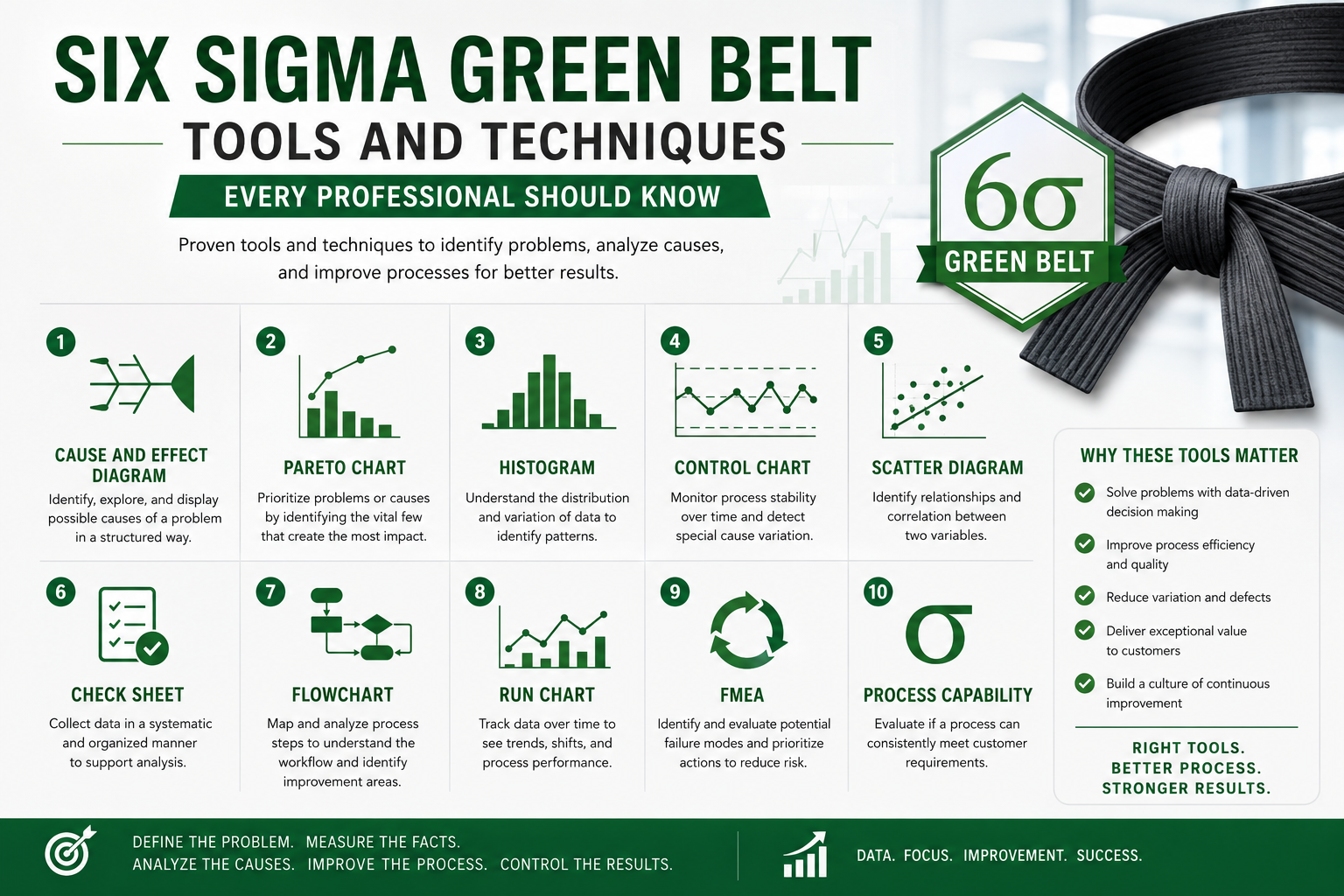
In the fast-paced world of business, efficiency and quality are paramount. For professionals striving to improve processes and increase productivity, the Six Sigma methodology offers a roadmap to excellence. Among its various levels, the Green Belt certification is particularly popular, empowering individuals with the tools and techniques necessary to drive improvement initiatives within their organizations. In this blog, we will explore essential Six Sigma Green Belt tools, the DMAIC methodology, and how these techniques can be effectively utilized in the Indian business landscape. Understanding Six Sigma and the Green Belt Role Six Sigma is a data-driven approach aimed at eliminating defects and improving processes. It emphasizes quality management through statistical methods, making it a valuable framework for any professional. The Green Belt certification represents a foundational level of expertise in Six Sigma, equipping individuals with the skills to lead projects and support Black Belts in more complex initiatives. The DMAIC Methodology: A Core Component At the heart of Six Sigma lies the DMAIC methodology, a structured approach to problem-solving. DMAIC stands for Define, Measure, Analyze, Improve, and Control. Understanding this framework is crucial for any Green Belt professional as it serves as the backbone for process improvement projects. 1. Define In the Define phase, the focus is on identifying the problem and setting project goals. This step involves gathering a team and brainstorming the project scope. Key tools used in this phase include: 2. Measure The Measure phase involves quantifying the current process performance. This is where data collection and analysis come into play. Essential tools include: 3. Analyze In the Analyze phase, the data collected is analyzed to identify the root causes of defects or issues. Key techniques include: 4. Improve The Improve phase focuses on developing solutions to address the root causes identified in the analysis phase. Tools utilized include: 5. Control The final phase, Control, ensures that the improvements made are maintained over time. Important tools for this phase include: Additional Six Sigma Green Belt Tools Beyond the DMAIC methodology, several other Six Sigma Green Belt tools and techniques can enhance project effectiveness: 1. Pareto Analysis The Pareto Principle, or the 80/20 rule, suggests that 80% of problems come from 20% of causes. By using this analysis, Green Belts can prioritize which issues to tackle first based on their impact. 2. SIPOC Diagram SIPOC stands for Suppliers, Inputs, Process, Outputs, and Customers. This high-level visual tool provides a comprehensive overview of the process and its key components, facilitating better understanding and communication among team members. 3. Value Stream Mapping This tool helps to visualize the flow of materials and information in a process, identifying waste and opportunities for improvement. It’s particularly useful in lean environments. 4. Root Cause Analysis (RCA) RCA is a systematic approach to identifying the root causes of problems. Techniques such as the 5 Whys and the Fishbone Diagram can be integrated into this analysis. Implementing Six Sigma Tools in the Indian Context As businesses in India increasingly adopt Six Sigma principles, understanding and implementing these tools effectively is vital. Here are a few tips for professionals looking to leverage Six Sigma Green Belt tools in the Indian market: FAQs About Six Sigma Green Belt Tools 1. What is the difference between Six Sigma Green Belt and Black Belt? Green Belts typically work on projects within their own departments and assist Black Belts, who lead larger, more complex projects across the organization. Green Belts have a foundational understanding of Six Sigma tools, while Black Belts possess advanced expertise. 2. How long does it take to get Six Sigma Green Belt certified? The duration for obtaining a Six Sigma Green Belt certification varies, but it usually takes around 2 to 3 months, depending on the training program and the individual’s commitment. 3. Are Six Sigma tools applicable to all industries? Yes, Six Sigma tools are versatile and can be applied across various industries, including manufacturing, healthcare, finance, and IT, to improve processes and enhance quality. 4. Can Six Sigma tools be used without certification? While certification provides a comprehensive understanding of Six Sigma principles and tools, professionals can still use basic Six Sigma tools for process improvement, albeit with limited effectiveness. Conclusion Mastering Six Sigma Green Belt tools and techniques, particularly the DMAIC methodology, is essential for professionals aiming to enhance process efficiency and quality. By leveraging these strategies, professionals in India can contribute to their organizations’ success and drive a culture of continuous improvement. Are you ready to take your skills to the next level? Invest in your Six Sigma Green Belt certification today and transform your career! Call to Action If you are looking to get certified or want to learn more about Six Sigma Green Belt tools and techniques, check out our comprehensive training programs tailored for Indian professionals. Join us now and start your journey towards excellence!

Pravin sahani
May 29, 2026
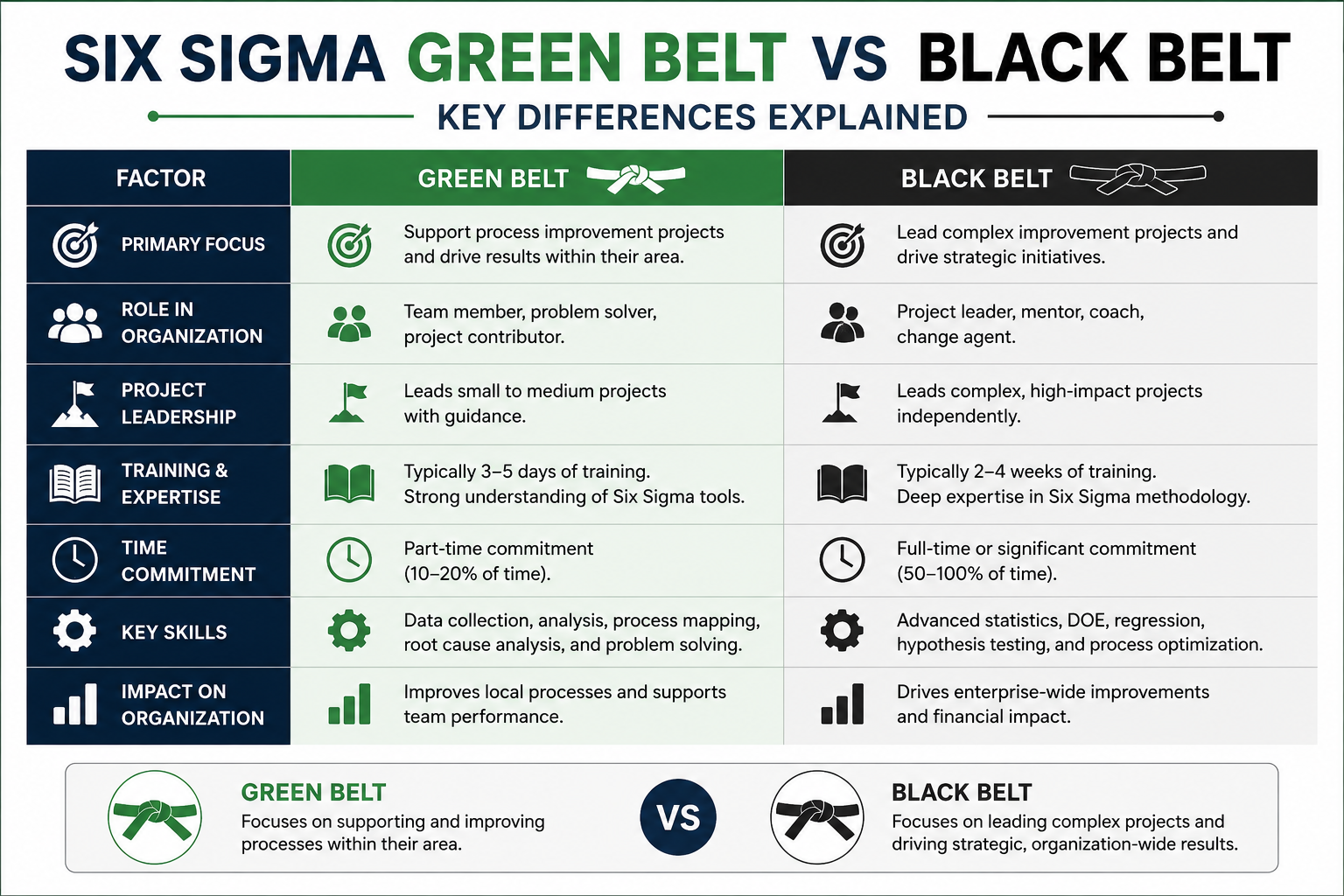
Six Sigma Green Belt vs Black Belt: Key Differences Explained

In today’s fast-paced business environment, organizations are constantly seeking ways to improve efficiency and reduce waste. One of the most effective methodologies for achieving these goals is Six Sigma. If you’re contemplating a career in quality management or looking to enhance your organization’s performance, you’ve likely encountered the terms "Green Belt" and "Black Belt." But what do these terms mean, and how do they differ? In this comprehensive guide, we’ll explore the key differences between Green Belt and Black Belt certifications in Six Sigma, helping you make an informed decision on which path to pursue. Understanding Six Sigma Certifications Six Sigma is a data-driven approach aimed at eliminating defects and improving processes. The methodology is divided into several levels of certification, primarily categorized into Green Belt and Black Belt. Both certifications have unique roles, responsibilities, and levels of expertise. Let’s delve deeper into what distinguishes them. What is a Six Sigma Green Belt? A Six Sigma Green Belt is a professional who has a solid understanding of Six Sigma principles and tools. They usually work under the supervision of Black Belts and are often involved in project teams that focus on process improvement. Green Belts typically devote part of their time to Six Sigma projects while also performing their regular job functions. Key Responsibilities of a Green Belt What is a Six Sigma Black Belt? A Six Sigma Black Belt is an expert in the Six Sigma methodology and is responsible for leading complex projects. Black Belts have a deeper understanding of statistical analysis and are equipped to mentor Green Belts and other team members. They play a crucial role in driving process improvements and fostering a culture of quality within an organization. Key Responsibilities of a Black Belt Green Belt vs Black Belt: Key Differences 1. Level of Expertise The primary difference between Green Belts and Black Belts lies in their level of expertise. While Green Belts have a foundational knowledge of Six Sigma principles, Black Belts possess advanced skills and are more proficient in data analysis and project management. 2. Scope of Responsibilities Green Belts typically work on smaller projects and assist Black Belts, while Black Belts lead larger, more complex projects. This difference in scope significantly impacts the responsibilities each role entails. 3. Time Commitment Green Belts often balance their Six Sigma responsibilities with their regular job duties. In contrast, Black Belts usually dedicate themselves full-time to Six Sigma projects, making it their primary focus. 4. Certification Requirements The certification process for Green Belts generally requires less training and fewer hours of project experience compared to Black Belts. While Green Belt training might consist of 30 to 40 hours, Black Belt training can exceed 100 hours. 5. Potential Career Impact Achieving a Black Belt certification can lead to higher-level positions within an organization and often results in increased salaries and greater career advancement opportunities compared to Green Belts. 6. Training and Tools Green Belt training covers fundamental Six Sigma tools such as DMAIC (Define, Measure, Analyze, Improve, Control) and basic statistical methods. Black Belt training, however, delves into more complex statistical techniques, process management, and leadership skills. Which Certification Should You Choose? Deciding between Green Belt and Black Belt certification largely depends on your career goals and current professional standing. If you're new to Six Sigma or looking to enhance your skills while maintaining your current job, a Green Belt certification is an excellent starting point. On the other hand, if you’re aiming for a leadership role in quality management and are ready to commit to a more rigorous training program, pursuing a Black Belt certification would be beneficial. Benefits of Six Sigma Certifications Regardless of which certification you choose, obtaining a Six Sigma certification can significantly enhance your career prospects. Here are some of the key benefits: FAQs 1. What is the duration of Six Sigma Green Belt and Black Belt training? Green Belt training generally lasts 30 to 40 hours, while Black Belt training can take 100 hours or more, depending on the training provider. 2. Can I pursue a Black Belt certification directly without a Green Belt? Yes, some certification bodies allow candidates to directly pursue a Black Belt certification if they have relevant experience and knowledge in Six Sigma methodologies. 3. How long is a Six Sigma certification valid? Six Sigma certifications do not expire, but it’s advisable to stay updated with the latest tools and techniques through continuous education and training. 4. Which industries value Six Sigma certifications the most? Six Sigma certifications are highly valued across various industries, including manufacturing, healthcare, finance, and IT, among others. Conclusion In conclusion, both Green Belt and Black Belt certifications in Six Sigma play vital roles in an organization's pursuit of quality and efficiency. Understanding the key differences between these two certifications can help you determine the right path for your career. Whether you opt for the Green Belt to gain foundational knowledge or aim for the Black Belt to lead significant change, both certifications will enhance your skill set and career potential. If you’re ready to take your first step towards Six Sigma certification, consider enrolling in a reputable training program today. Start your journey towards becoming a leader in quality management! Call to Action: Interested in Six Sigma training? Contact us today to find out more about our Green Belt and Black Belt certification programs tailored for the Indian audience!

Pravin sahani
May 29, 2026
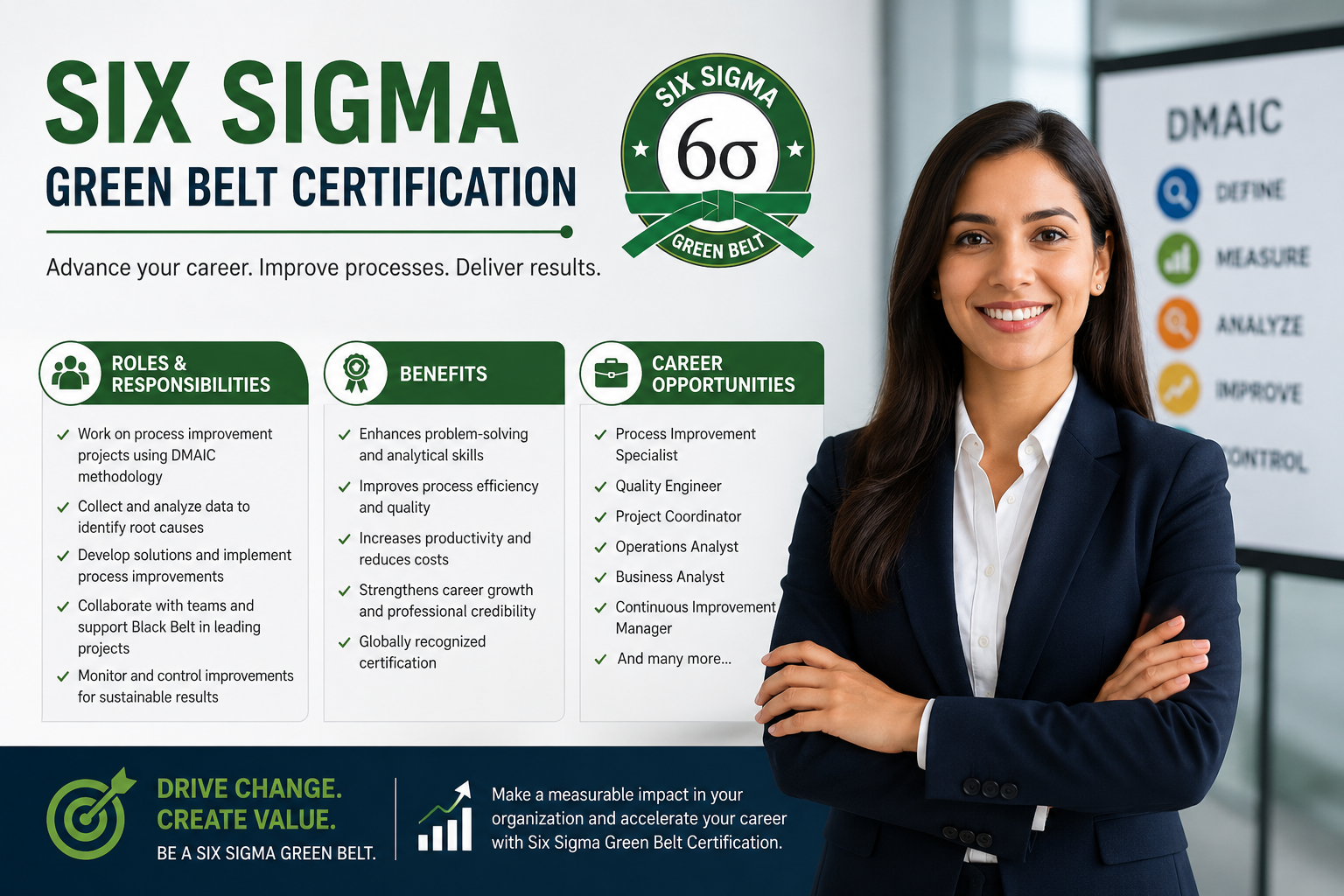
What is Six Sigma Green Belt Certification? Roles, Benefits & Career Opportunities

In today’s competitive business landscape, organizations are constantly seeking ways to improve efficiency, reduce costs, and enhance customer satisfaction. One of the most effective methodologies to achieve these goals is Six Sigma. Among the various levels of Six Sigma certification, the Six Sigma Green Belt Certification holds significant importance. This certification empowers professionals to drive process improvement initiatives and contribute to an organization's overall success. In this blog, we will explore what Six Sigma Green Belt Certification is, its roles, benefits, and the career opportunities it presents, especially for the Indian audience. What is Six Sigma Green Belt Certification? The Six Sigma Green Belt Certification is a professional credential that signifies an individual's knowledge and proficiency in the Six Sigma methodology. This certification is designed for professionals who are involved in process improvement projects and are responsible for managing small-scale projects or assisting Black Belts in larger projects. Green Belts use statistical tools and techniques to analyze data, identify inefficiencies, and implement solutions that enhance operational performance. Understanding Six Sigma and Lean Six Sigma Before delving deeper into Green Belt certification, it’s essential to understand what Six Sigma and Lean Six Sigma entail. Six Sigma is a data-driven approach aimed at reducing defects and improving processes. It follows a structured methodology known as DMAIC (Define, Measure, Analyze, Improve, Control). On the other hand, Lean Six Sigma combines the principles of Lean manufacturing, which focuses on waste reduction, with Six Sigma's goal of improving quality. Together, they form a powerful toolkit for organizations aiming to enhance performance. Roles of a Six Sigma Green Belt A certified Green Belt professional plays various crucial roles within an organization. Here are some of the primary responsibilities: 1. Project Management Green Belts are often tasked with managing projects that require process improvement. They lead teams, set project goals, and ensure that the project stays on track. 2. Data Analysis Green Belts utilize statistical tools to collect and analyze data, helping to identify root causes of problems and areas for improvement. 3. Cross-Functional Collaboration Working collaboratively with different departments is vital. Green Belts often liaise between teams to ensure that everyone is aligned and working towards common goals. 4. Training and Mentoring Experienced Green Belts may also take on the role of trainers or mentors, guiding new team members on Six Sigma principles and practices. 5. Implementation of Solutions Once data has been analyzed, Green Belts are responsible for implementing solutions and monitoring their effectiveness over time. Benefits of Six Sigma Green Belt Certification Obtaining a Green Belt certification comes with numerous advantages that can significantly impact your career trajectory. Here are some of the key benefits: 1. Enhanced Skill Set With Six Sigma Green Belt training, professionals acquire a robust set of analytical and problem-solving skills, which are highly valued in various industries. 2. Increased Job Opportunities Many organizations in India and globally prefer candidates with Six Sigma certifications, leading to a higher chance of being hired or promoted. 3. Higher Earning Potential Certified professionals often command higher salaries compared to their non-certified counterparts, making Green Belt certification a lucrative investment. 4. Contribution to Organizational Success By implementing effective process improvements, Green Belts play a crucial role in enhancing overall business performance, which can lead to job stability and advancement. 5. Networking Opportunities Joining the Six Sigma community allows professionals to network with like-minded individuals, share knowledge, and learn from industry leaders. Career Opportunities for Six Sigma Green Belt Certified Professionals The demand for Six Sigma professionals is on the rise, and Green Belt certification opens up a plethora of career opportunities across various sectors. Here are some potential career paths: 1. Process Improvement Specialist These specialists focus on analyzing and improving business processes. They work closely with teams to implement strategies for increased efficiency. 2. Quality Assurance Manager Quality assurance managers play a vital role in ensuring that products and services meet predefined quality standards. Six Sigma principles guide their approach to quality control. 3. Operations Manager Operations managers oversee day-to-day operations and implement process improvements to enhance productivity and reduce costs. 4. Project Manager Many organizations seek professionals with a Six Sigma background to lead projects focused on quality improvement and process optimization. 5. Business Analyst Business analysts utilize their analytical skills to assess business needs and recommend solutions, often using Six Sigma methodologies. How to Obtain Six Sigma Green Belt Certification Gaining Six Sigma Green Belt certification involves several steps: 1. Choose a Reputable Training Provider Select a recognized institution or training provider that offers comprehensive Six Sigma Green Belt training. Look for providers that offer online and offline options, catering to your learning preferences. 2. Complete the Training Program Engage in the training course, which typically covers Six Sigma principles, tools, and techniques necessary for effective process improvement. 3. Gain Practical Experience Real-world experience is crucial. Many training programs require candidates to complete a project demonstrating their ability to apply Six Sigma methodologies. 4. Pass the Certification Exam After completing the training, candidates must pass a certification exam. This assessment evaluates the knowledge and skills acquired during the training process. 5. Maintain Certification Some organizations require ongoing education or re-certification to ensure that professionals stay updated with the latest practices and technologies. FAQs 1. What is the duration of Six Sigma Green Belt training? The duration of Six Sigma Green Belt training can vary, but it typically lasts between 2 to 5 days, depending on the provider and the course format. 2. Is Six Sigma Green Belt certification recognized globally? Yes, Six Sigma Green Belt certification is recognized worldwide and is highly valued in various industries, including manufacturing, healthcare, IT, and finance. 3. Can I pursue Six Sigma Green Belt certification online? Absolutely! Many reputable institutions offer online Six Sigma Green Belt training programs, allowing you to study at your own pace and convenience. 4. Are there any prerequisites for Six Sigma Green Belt certification? Generally, there are no formal prerequisites for Six Sigma Green Belt certification. However, familiarity with basic statistics and process management can be beneficial. 5. How much can I expect to earn with Six Sigma Green Belt certification? Salary can vary based on experience, industry, and location, but Six Sigma Green Belt certified professionals in India typically earn between INR 6 lakh to INR 12 lakh per annum. Conclusion In conclusion, obtaining a Six Sigma Green Belt Certification is a valuable step for professionals looking to advance their careers and contribute significantly to their organizations. The certification not only equips individuals with essential process improvement skills but also opens doors to numerous career opportunities in a variety of sectors. Whether you are looking to enhance your skill set, increase your earning potential, or drive organizational success, pursuing Six Sigma Green Belt training is a decision that can yield significant rewards. Are you ready to take the next step in your career? Invest in your future today by enrolling in a Six Sigma Green Belt training program! Explore various options available and start your journey towards becoming a process improvement leader.